E-Invoicing Requirements by Country 2026: Mandates & Deadlines
Compare e-invoicing requirements in eight European markets: active mandates, future deadlines, B2B and B2G scope, with official sources checked in October 2026.

By Tailride · Sources checked 29 October 2026
E-invoicing requirements differ by country, transaction and business size. As of 29 October 2026, Italy and Belgium have broad domestic regimes in force, Germany is phasing in issuance after its receiving requirement, and France has started its first business rollout. Spain has set later implementation dates. The UK and the Netherlands have announced future programmes whose detailed domestic rules are still being developed.
This guide compares eight selected European markets, including the UK. It separates obligations already in force from scheduled requirements and government plans, then explains how to identify the deadline that applies to an individual business. It is a requirements reference, rather than a worldwide mandate inventory or an adoption ranking.
E-invoicing deadlines at a glance
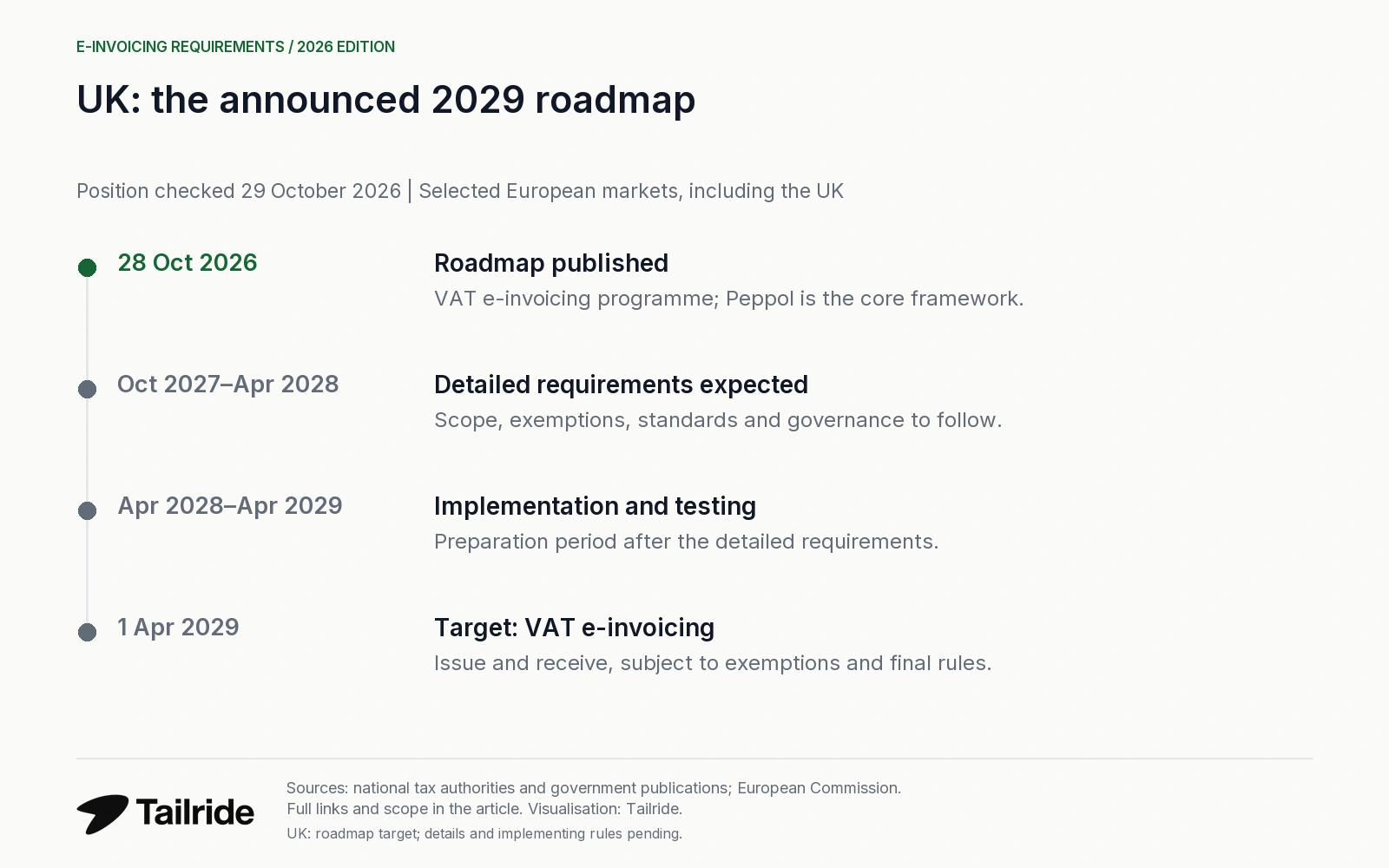
The first question is whether a rule covers receiving, issuing or reporting. A business may already need to receive structured invoices while still being allowed to send paper or PDF invoices during a transition.
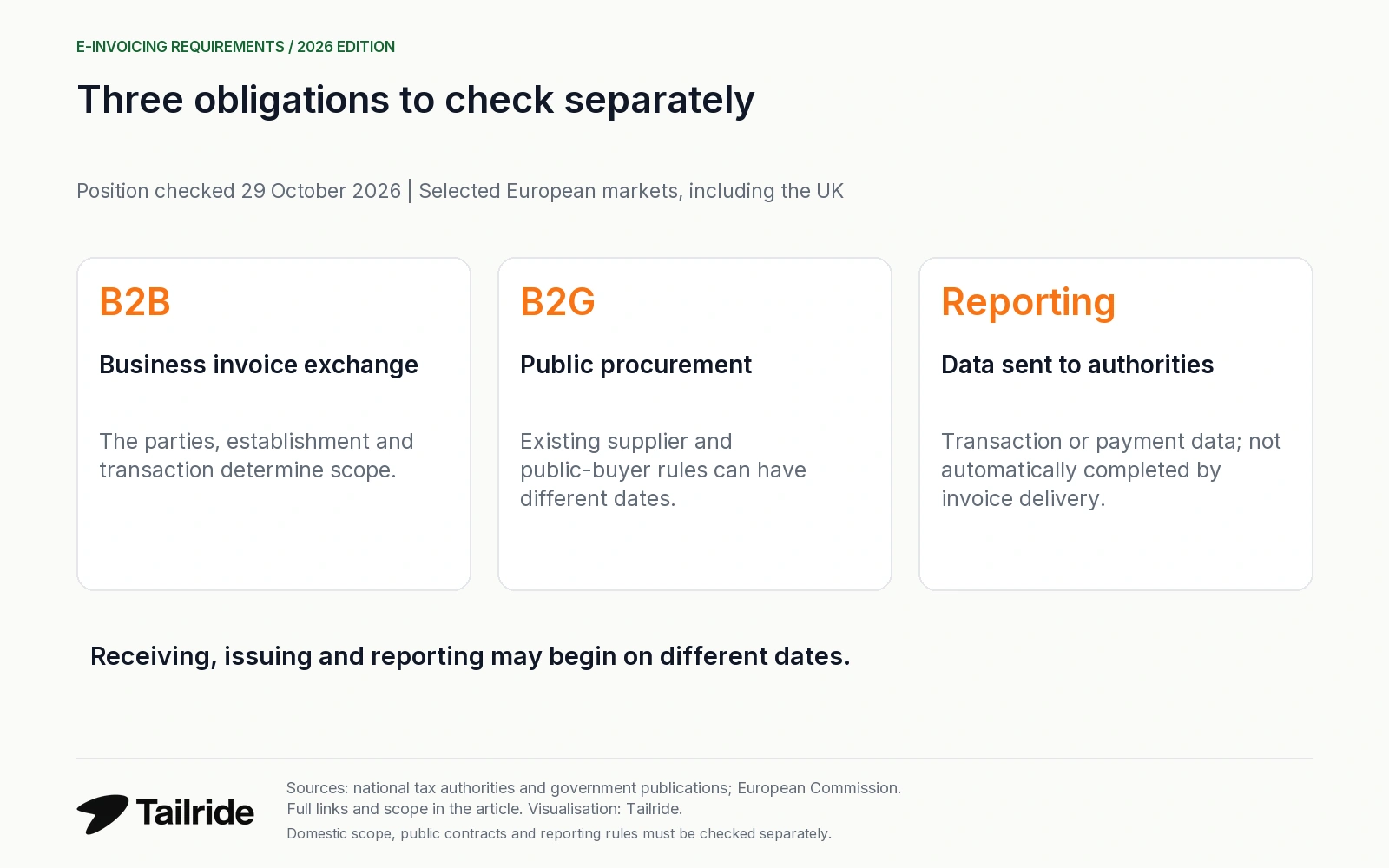
| Country | Domestic B2B position on 29 October 2026 | Key date or next stage | Official source |
|---|---|---|---|
| Germany | Receiving required; issuance transition continues | 1 Jan 2027 for issuers above €800,000 previous-year turnover; remaining covered issuers from 1 Jan 2028 | BMF FAQ |
| France | Receiving required for covered businesses; large companies and intermediate-sized enterprises already issue | 1 Sep 2027: SME and microenterprise issuance | DGFiP calendar |
| Italy | Domestic regime already in force, subject to exclusions | Main regime since 1 Jan 2019; remaining forfettari included from 1 Jan 2024 | Tax authority notice, forfettari guidance |
| Belgium | Structured invoices required for nearly all covered domestic VAT-liable B2B transactions | 1 Jan 2026: issue and receive | FPS Finance |
| Spain | Future B2B stages established | 6 Oct 2027 above €8m previous-year VAT turnover; 6 Oct 2028 for other covered businesses | AEAT calendar |
| Portugal | The dates cited here concern public procurement, not a broad domestic B2B mandate | 1 Jan 2027: microenterprise and SME B2G supplier stage under current rules | eSPap FAQ, 2026 Budget law |
| Netherlands | Government plan; domestic implementing bill still to be developed | Planned: B2B e-invoicing 1 Jul 2030; domestic reporting 1 Jul 2031 | Government announcement |
| United Kingdom | Announced programme; detailed requirements and implementing rules pending | Target: issue and receive VAT e-invoices from 1 Apr 2029 | HMRC / DBT roadmap |
Germany's dates retain statutory exceptions and a separate legacy-EDI transition through the end of 2027. The turnover thresholds refer to the issuer, not the customer. Portugal's B2G date must not be copied into a column labelled “all B2B businesses”.
UK e-invoicing mandate: what the 2029 roadmap actually says
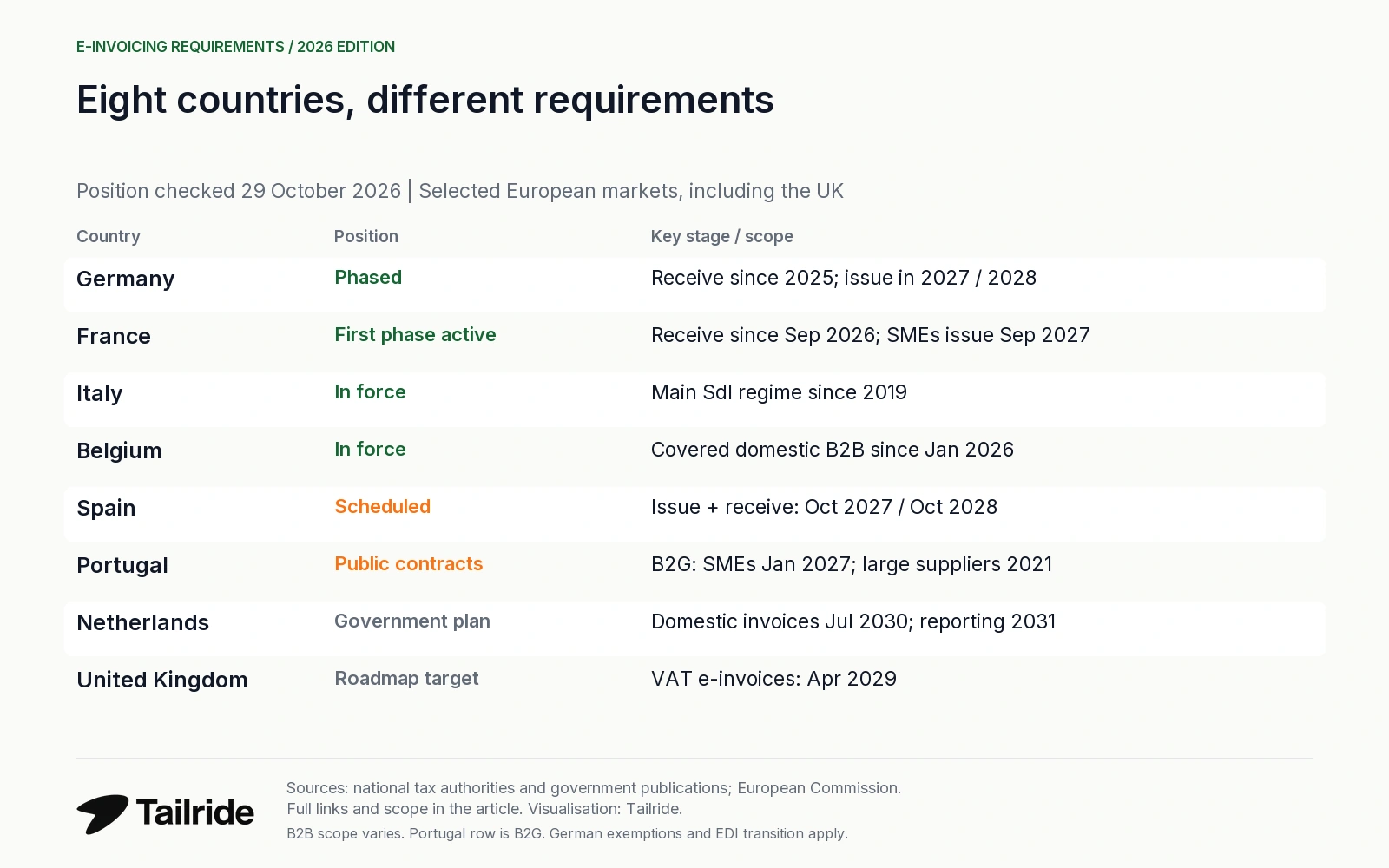
The UK roadmap published on 28 October 2026 gives a target of 1 April 2029 for VAT-registered persons, including public bodies, to issue and receive VAT invoices as e-invoices, subject to exemptions. It identifies Peppol as the core interoperability framework. This is a programme announcement with further legislation and detailed requirements to follow, rather than a complete technical rulebook already in force. Official roadmap.
| Milestone | Published position |
|---|---|
| 28 Oct 2026 | Implementation roadmap published |
| Oct 2027–Apr 2028 | Detailed requirements expected, including scope, exemptions, standards and governance |
| Apr 2028–Apr 2029 | Implementation, testing and preparation period |
| 1 Apr 2029 | Target date for the VAT e-invoicing requirement |
The practical distinction is between planning now and assuming that every compliance detail is final. Organisations can map invoice sources, customer identifiers and software dependencies. Product selection should account for the detailed rules as they are published. The roadmap provides for at least 12 months to prepare after the detailed requirements are set out.
It also discusses digital reporting separately. Consultation on possible reporting does not establish an automatic 2029 real-time tax-reporting obligation. Treat invoicing, network access and any future reporting rules as separate requirements. Scope and reporting discussion.
Germany and France: receiving comes before full issuance
Germany: domestic businesses have needed to be able to receive e-invoices since 1 January 2025. All issuers can use the general transition through 2026; issuers with previous-year turnover of no more than €800,000 have an additional year. Certain non-compliant legacy EDI arrangements can continue through 2027. Kleinunternehmer are exempt from mandatory issuance but still need to receive; small-value invoices up to €250 gross and other specified cases also have issuance exceptions. A foreign VAT registration alone does not make a business domestically established for this rule. BMF scope, exceptions and transitions.
France: 1 September 2026 has already passed. Covered businesses must receive e-invoices, and large companies plus intermediate-sized enterprises must issue them. SMEs and microenterprises follow for issuance on 1 September 2027. Businesses under the franchise en base VAT exemption can still fall within the reform: “not charging VAT” is not a sufficient exemption test. DGFiP.
France also requires the appropriate plateforme agréée, or approved platform. A document viewer or accounting application is not automatically such a platform. The tax authority expressly distinguishes an approved platform from a compatible solution that connects to one. Approved-platform rules.
Spain: fixed dates in 2027 and 2028, with a separate 2029 reporting stage
Spain's Real Decreto 238/2026 establishes the framework. Orden HAC/1028/2026 took effect on 6 October 2026, starting the implementation clock. The AEAT now publishes these dates explicitly:
| Obligation | Covered group | Effective date |
|---|---|---|
| Issue and receive e-invoices | Previous-year VAT turnover above €8 million | 6 Oct 2027 |
| Issue and receive e-invoices | Other covered businesses and professionals | 6 Oct 2028 |
| Communicate invoice and payment status | Above the €8 million threshold | 6 Oct 2027 |
| Communicate invoice and payment status | Other legal persons and entities, except the following group | 6 Oct 2028 |
| Communicate invoice and payment status | Other individuals and income-attribution entities | 6 Oct 2029 |
Sources: Royal Decree, ministerial order, AEAT implementation calendar.
The 2029 date is not a general extension for sole traders to start issuing invoices. It concerns a later status-reporting stage. Large issuers must also provide a readable PDF companion during their first 12 months; that PDF accompanies the structured invoice rather than replacing it. The B2B reform is separate from invoice-software integrity requirements often discussed as Veri*Factu. Calendar, software regulation.
Italy, Belgium and Portugal: three different starting points
Italy's domestic electronic-invoicing regime is established, with the main SdI requirement dating to 2019. The remaining forfettari joined from 2024. A company trading with Italy should check establishment, transaction and sector-specific exclusions rather than treating any Italian VAT number as proof that every invoice follows the same route. Agenzia delle Entrate, forfettari extension.
Belgium's broad B2B requirement began on 1 January 2026. Its small-business VAT exemption does not, by itself, remove the structured-invoicing duty. Businesses carrying out only exempt Article 44 activities and foreign businesses without a Belgian fixed establishment have specific exclusions. This is a different small-business treatment from Germany's. Official scope guidance.
Portugal's current 1 January 2027 milestone concerns microenterprise and SME public-contract suppliers; large suppliers have been covered since 2021. Separately, Article 95(3) of the 2026 Budget law recognises PDF invoices for fiscal-law purposes through 31 December 2026. This does not turn a PDF into a structured public-procurement invoice or create a universal private-sector B2B mandate for 2027. eSPap, Budget law, Articles 95 and 260.
B2B, B2G and tax reporting are separate obligations
| Requirement | What it governs | What it does not establish on its own |
|---|---|---|
| B2B e-invoicing | Invoice exchange between businesses within a defined national scope | A universal requirement for every foreign supplier |
| B2G e-invoicing | Invoicing under covered public-procurement contracts | The same deadline for private-sector customers |
| Digital reporting | Sending prescribed transaction or payment data to an authority | That exchanging an invoice alone completes the reporting duty |
The EU public-procurement directive requires covered contracting authorities to receive and process compliant invoices. It does not itself make every supplier in Europe issue e-invoices in every transaction; national rules determine additional obligations. European Commission explanation.
Does ViDA make e-invoicing compulsory everywhere in 2030?
No. The EU's VAT in the Digital Age package establishes 1 July 2030 as the start of digital reporting based on e-invoicing for covered cross-border B2B transactions. Domestic mandates have their own national scope and schedules. Existing domestic real-time reporting systems must align with the EU model by 1 January 2035. European Commission ViDA timeline.
The Netherlands illustrates the distinction: its government plans domestic B2B e-invoicing for 1 July 2030, followed by domestic digital reporting on 1 July 2031. The national bill is expected before summer 2027; these domestic dates are government plans at this guide's verification date. Existing central-government supplier requirements are a separate, older regime. Dutch announcement, Logius public-sector guidance.
Which delivery channel is required?
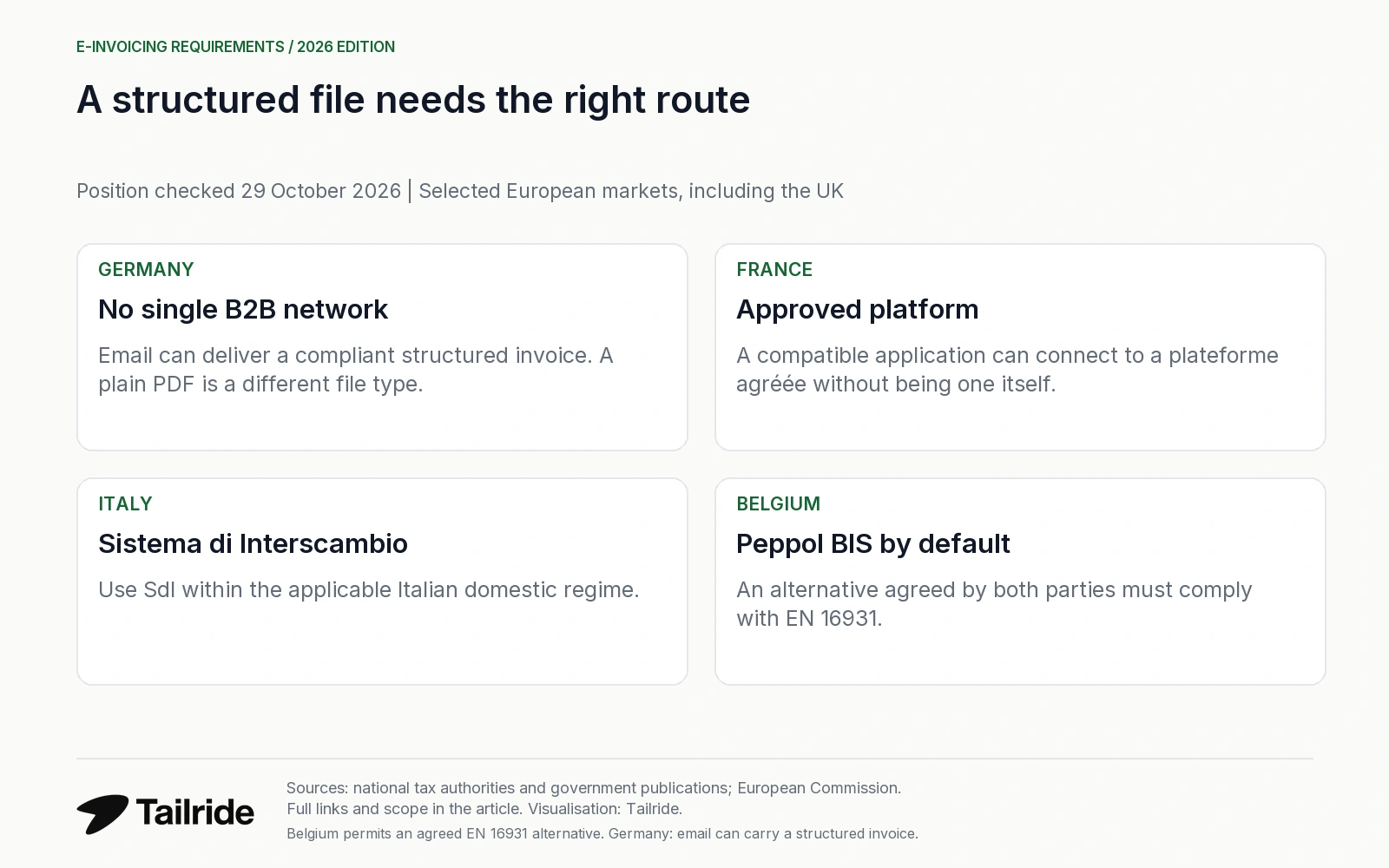
A structured file and a compliant delivery route solve different parts of the problem. A correct XML invoice can still need transmission through the relevant national channel.
| Country | Relevant route for the covered domestic regime |
|---|---|
| Germany | No single mandatory B2B network; email can deliver a compliant structured invoice |
| France | Approved-platform framework; a compatible application may connect to a plateforme agréée |
| Italy | Sistema di Interscambio, within the relevant SdI scope |
| Belgium | Peppol BIS is the default; a mutually agreed alternative must meet EN 16931 |
Sources: BMF, DGFiP, Agenzia delle Entrate, Belgian FPS Finance.
How to identify your business's applicable deadline
-
Identify the establishment involved. Record the legal entity and relevant fixed establishment; a VAT registration may not be enough.
-
Classify the transaction. Separate domestic B2B, cross-border business, public procurement and consumer sales.
-
Apply the local scope tests. Use the specified turnover period, business category and exemptions. Germany's €800,000 threshold and Spain's €8 million threshold are different tests.
-
Map receiving, issuing and reporting separately. Assign an owner and an effective date to each obligation.
-
Check the exchange route and original document. Confirm the required provider or network, preserve the structured file and verify any separate reporting and retention arrangements.
Tailride's documented invoice workflow can read supported structured invoice files, preserve the original XML and provide a readable PDF view. Those capabilities help with document handling; a file import does not by itself establish that a national exchange, reporting or statutory archiving requirement has been fulfilled. Tailride documentation. For file-level handling, see our ZUGFeRD, Factur-X and XRechnung guide. For adoption and invoice-volume data, use the separate e-invoicing statistics article.
Frequently asked questions
Is a PDF sent by email an e-invoice?
A plain PDF is not a structured e-invoice merely because it arrives electronically. Germany allows certain paper and PDF invoices during its issuance transition; Belgium's covered B2B regime requires structured invoices. Portugal's temporary fiscal recognition of PDFs is a separate legal rule. Germany, Belgium, Portugal.
Can a small business be exempt from sending but still have to receive?
Yes. German Kleinunternehmer are an explicit example. France also starts receiving for covered SMEs before their mandatory issuance stage. Do not infer receiving obligations from the outgoing-invoice deadline. BMF, DGFiP.
Does a foreign customer's mandate automatically apply to my company?
Not necessarily. Establishment and transaction scope matter. Germany and Belgium distinguish foreign VAT registration from local establishment. A customer may also request a particular invoice format contractually even where the national mandate does not cover the supplier. German scope, Belgian scope.
Are the UK and Dutch future dates already complete legal specifications?
No. They are published programme dates with further domestic rules to follow. The UK expects detailed requirements in 2027–2028; the Netherlands says its implementing bill is still being developed. UK roadmap, Dutch announcement.
Scope and verification method
Sources were checked on 29 October 2026. Dates come from legislation, tax authorities and official government publications. “In force”, “scheduled” and “government plan” describe different levels of implementation certainty; a plan is not presented as a completed domestic law. This selected-country guide does not reproduce every sectoral exception, public contract or retention rule. Charts visualise the cited requirements, not invoice adoption rates or forecasts. Check the applicable official text again when making an implementation decision, particularly where legislation or annual extensions remain pending.
Sources and official guidance
-
Agenzia delle Entrate - Fatturazione elettronica dal 1° gennaio 2019 (PDF)
-
FiscoOggi / Agenzia delle Entrate - Forfettari e fatturazione elettronica, 15/02/2023 (PDF)
-
Belgian FPS Finance - Structured electronic invoices compulsory from 2026
-
Diário da República - Lei n.º 73-A/2025, artigos 95.º e 260.º (PDF, pp. 59, 114)
-
Rijksoverheid - Kabinet kiest voor invoering e-facturatie en rapportage, 11/09/2026
-
HMRC / DBT - Roadmap for e-invoicing implementation, 28/10/2026
-
BOE - Real Decreto 1007/2023: sistemas informáticos de facturación
-
SPF Finances - Pour qui la facturation électronique devient-elle obligatoire ?
-
European Commission - Compliance with the eInvoicing Directive
-
Tailride - Invoices: structured files, originals and PDF previews
