
How to Get Invoices into Holded Automatically (2026)
Holded's scanner is unlimited, so cost is not the constraint. Whether a captured ticket lets you deduct the IVA is. Three routes compared, plus Tailride.

Last updated: August 2026 · ~11 min read · Published by Tailride
Holded is unusual in this category, and in a good way: its document scanner is unlimited and included in every plan. No credits, no per-document fee, no tier gate. Upload a thousand supplier invoices this month and it costs the same as uploading ten.
Which means the question most comparison guides answer - how much does capture cost - has no interesting answer here. The constraint sits somewhere else, and in Spain it is a tax question rather than a pricing one: does the document you just captured actually let you deduct the IVA? (IVA is Spanish VAT.)
For a large share of what a Spanish business receives, the honest answer is no. This guide covers the three native routes into Holded, what each one extracts, and the field checks that decide whether your IVA soportado - the VAT you paid on purchases and want back - survives a review.
Holded's own routes wait for a document, then read its header. Two things stay on you: getting hold of the documents that never arrive by email, and looking at each one closely enough to know whether the IVA on it is recoverable. Tailride takes the first off your hands and makes the second quick. It fetches the documents out of Gmail, Outlook, supplier portals and however far back your mailbox goes, reads each one down to the line with the rate the document states rather than one inferred from the total, and maps it to your accounts with the original still attached - so the tax check is a glance at a queue instead of an archaeology project. Free for 10 invoices a month, then from €12 a month billed annually. See the Holded integration →
Short answer
Use Holded's Inbox address - a mailbox Holded gives you, not your own - if your suppliers already send PDFs by email. It is the least work for the most coverage, and it is free.
Use the Scanner tab for paper, photographs, and anything over the email size limit.
Use the API if invoices already exist as structured data in a system you control.
Put a capture layer in front of Holded if the documents are not reaching you in the first place - portals, unforwarded inboxes, a back catalogue - or if you need the tax read per line and the deductibility fields checked before anything posts.
The three ways in, and what each one does
1. Upload to the Scanner
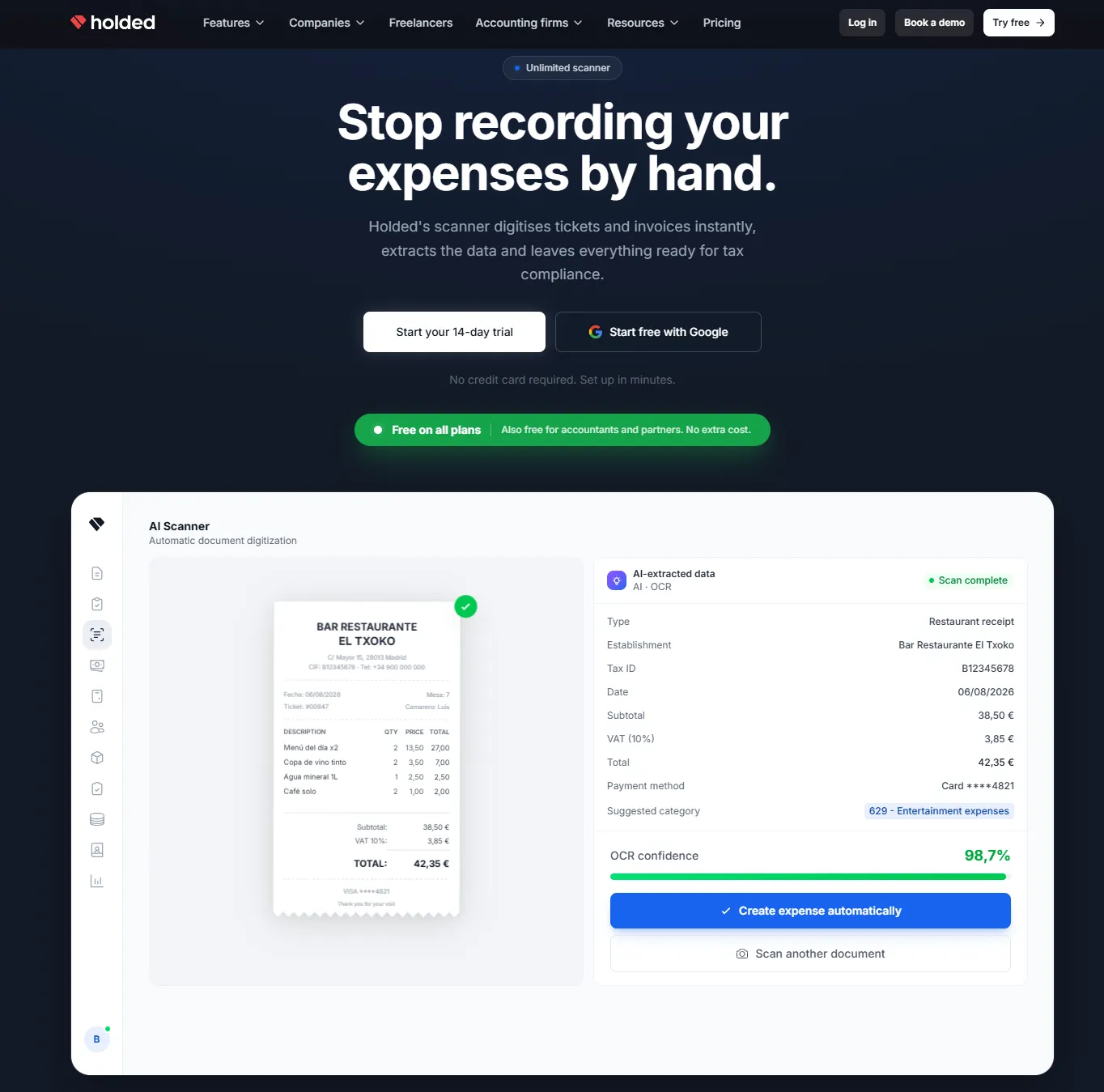
The direct route, and note that it moved: the Scanner now has its own tab in the main navigation rather than sitting inside Purchases (Gastos in the Spanish interface - Holded's own docs call this section Purchases in some places and Expenses in others). Upload a PDF or an image there, or photograph it in the mobile app, and Holded's OCR reads the document and queues it for review. Once you confirm, it becomes a purchase document and generates its accounting entry.
Holded documents the extracted fields as issuer, amount, date, taxes and document type (Holded Academy). Read that list once more and notice what is absent from it: anything about the recipient. Hold that thought - it is the whole of the next section.
The scanner is unlimited on every plan, which is worth restating because almost nothing else in this market works that way. Sage meters AI Capture by transaction. Odoo consumes an IAP credit per PDF. Dext bills line-item extraction by credit. Holded simply does not charge for it.
The limit here is not volume but file size: manual uploads cap at 5 MB. A scanned multi-page invoice from a flatbed at high resolution will exceed that more often than you would expect.
2. The Inbox email address
Holded gives every company a unique email address. Anything forwarded there lands in the same Scanner queue as an upload, gets read, and waits for confirmation.
This is the route that scales without anyone clicking. Two ways to use it:
-
Tell suppliers to send there directly. Cleanest, and the hardest to get suppliers to actually do.
-
Auto-forward from your existing AP mailbox. A rule in Gmail or Outlook that forwards anything matching factura, recibo or a known sender. Faster to set up, and it will miss whatever your rule does not match.
The size ceiling is higher by email: 17 MB, and if a message exceeds it the sender gets a warning back rather than the document silently vanishing. That warning behaviour is better than most tools manage, but note who receives it - if the supplier sent the file, the supplier gets the bounce, and you may not learn about it.
3. The API
Holded exposes a REST API that creates purchase invoices directly. The right tool when the data already exists in structured form somewhere you control: a POS, an ERP, a procurement system.
The wrong tool when sixty suppliers each send a PDF in their own layout. At that point the API is the easy half and the reading is the hard half, and the API does not do the reading.
The part that decides whether you can deduct the IVA
Here is where a Spanish business gets caught, and it has nothing to do with which upload button you pressed.
Spanish rules allow a factura simplificada - what everyone calls a ticket - for operations up to €400 including IVA, and up to €3,000 in certain regulated sectors (AEAT: tipos de factura). Fuel, taxis, restaurants, parking, hardware shops, couriers. A meaningful slice of what any business spends.
A simplified invoice is a valid document. It is not automatically a deductible one.
To deduct the IVA on a simplified invoice, the issuer has to have included three things beyond the usual supplier details:
-
Your NIF as the recipient - the Spanish tax identification number
-
Your name and address
-
The cuota repercutida stated separately, with the rate applied - that is, the IVA amount shown as its own figure rather than folded into the total
Miss any of those and the IVA is not recoverable, however carefully you filed the document (AEAT: facturas simplificadas).
Now read that against what the native routes extract: issuer, amount, date, taxes, document type. Every one of those describes the sender or the money. Nothing in the set answers is my NIF on this document.
Holded is not hiding this. Its own documentation defines the simplified purchase invoice as proof of payment that "only includes tax data from the issuer" - which is precisely the document that fails the deduction test. The classification is right there in the product. What the product does not do is act on it.
So the workflow quietly produces two categories of record that look identical in your books:
| What you have | What it looks like once confirmed | Can you deduct the IVA? |
|---|---|---|
| Full factura with your NIF and separated IVA | Supplier, date, total | Yes |
| Ticket with your NIF and separated cuota | Supplier, date, total | Yes |
| Ticket without your NIF | Supplier, date, total | No |
| Ticket with IVA folded into one figure | Supplier, date, total | No |
Four documents, one appearance. The difference surfaces when somebody reviews the libro registro de facturas recibidas, the ledger of invoices received, against the deductions claimed, which is a long way downstream of the moment it could have been fixed for free by asking the supplier for a proper invoice.
The practical rule: the check has to happen at capture, while you can still go back to the supplier. A tool that stores a total and moves on has removed the typing and left the exposure exactly where it was.
There is one useful property of line-level extraction here, and it holds whatever tool you use. If the document does not state the cuota separately, no extraction can show it separately - the absence in your data mirrors the absence on the paper. A record that comes back with a taxable base, a rate and a cuota as three distinct figures came from a document that stated them. A record with one lump did not. That is not a compliance verdict, but it is a signal you can sort a queue by, and header-only capture does not give you even that.
Worth asking any vendor in this category, us included: what does your output look like for a ticket that has no recipient NIF? If the answer is "the same as any other receipt", the deductibility question is still entirely yours.
Where the automatic routes leave you exposed
Setting the tax question aside, three gaps are worth naming before you build a workflow on any of these.
They all start with a document that already reached you. The invoice behind an Amazon Business or Meta Ads login is not in your inbox and never will be. Neither is the one a colleague received and did not forward. Neither are the eight months of history from before you set the Inbox address up. The Inbox is a receiver, not a collector.
Header extraction cannot be coded per line. One builder's merchant invoice mixing materials, tooling and delivery arrives as a single figure. Splitting it across accounts, and applying 21% to some lines and 10% or 4% to others, is manual work every time.
Nothing validates the totals against each other. Base plus cuota should equal the total. When OCR misreads a digit, the arithmetic stops working, and a header-only record has no second number to check the first against.
What changes before 2028
Two Spanish deadlines are worth having in view, because both change what arrives and what your software has to do with it. Both have already moved once, so treat the dates as current rather than settled.
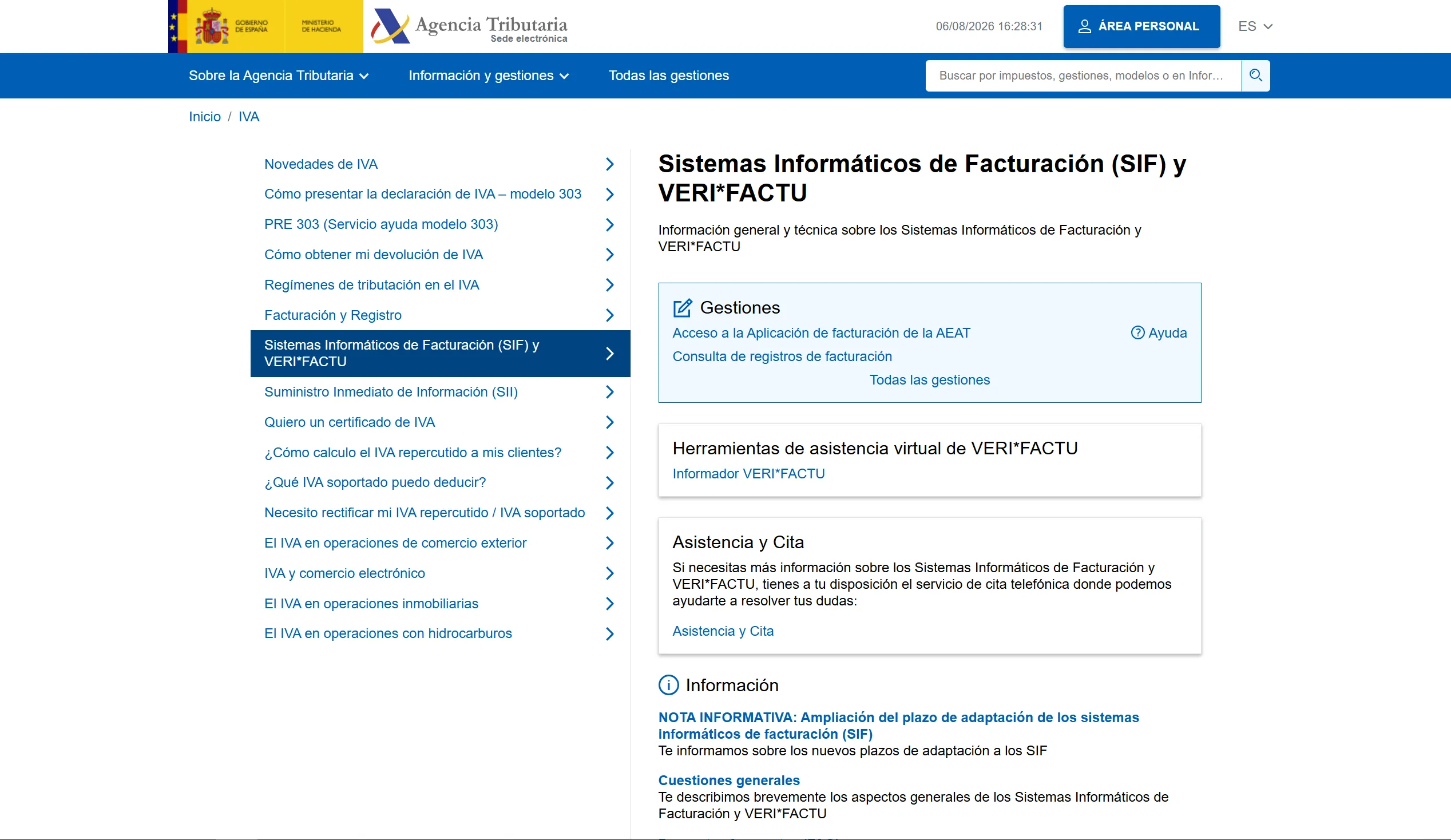
Verifactu. Billing software used in Spain has to meet the AEAT's requirements for sistemas informáticos de facturación. Real Decreto-ley 15/2025, published on 3 December 2025, pushed the calendar back a year: 1 January 2027 for companies paying Impuesto sobre Sociedades, the Spanish corporate income tax, and 1 July 2027 for everyone else (AEAT: SIF y VERI*FACTU). Software vendors had to be ready by 29 July 2025, and holding non-compliant billing software carries penalties up to €50,000.
One thing to be clear about, since a lot of coverage blurs it: Verifactu governs the invoices you issue, not the ones you receive. It matters for Holded as your billing system. It does not impose requirements on your supplier-invoice capture.
Mandatory B2B e-invoicing. The Ley Crea y Crece framework does affect what you receive. Real Decreto 238/2026 set out the architecture, the accepted formats and the interconnection rules, with the ministerial order taking effect 1 October 2026 and the obligation phasing in from October 2027 for businesses turning over more than €8 million and October 2028 for everyone else. The reference format is the European standard EN 16931, with UBL as the primary syntax.
The consequence for capture is simple enough, and mostly good: a growing share of supplier invoices will arrive as structured data rather than PDFs, and structured data needs no OCR at all. Until that transition completes, you are running both worlds at once - which is the argument for a capture layer that handles PDFs, images and structured files through the same pipeline rather than three separate ones.
Adding Tailride in front of Holded
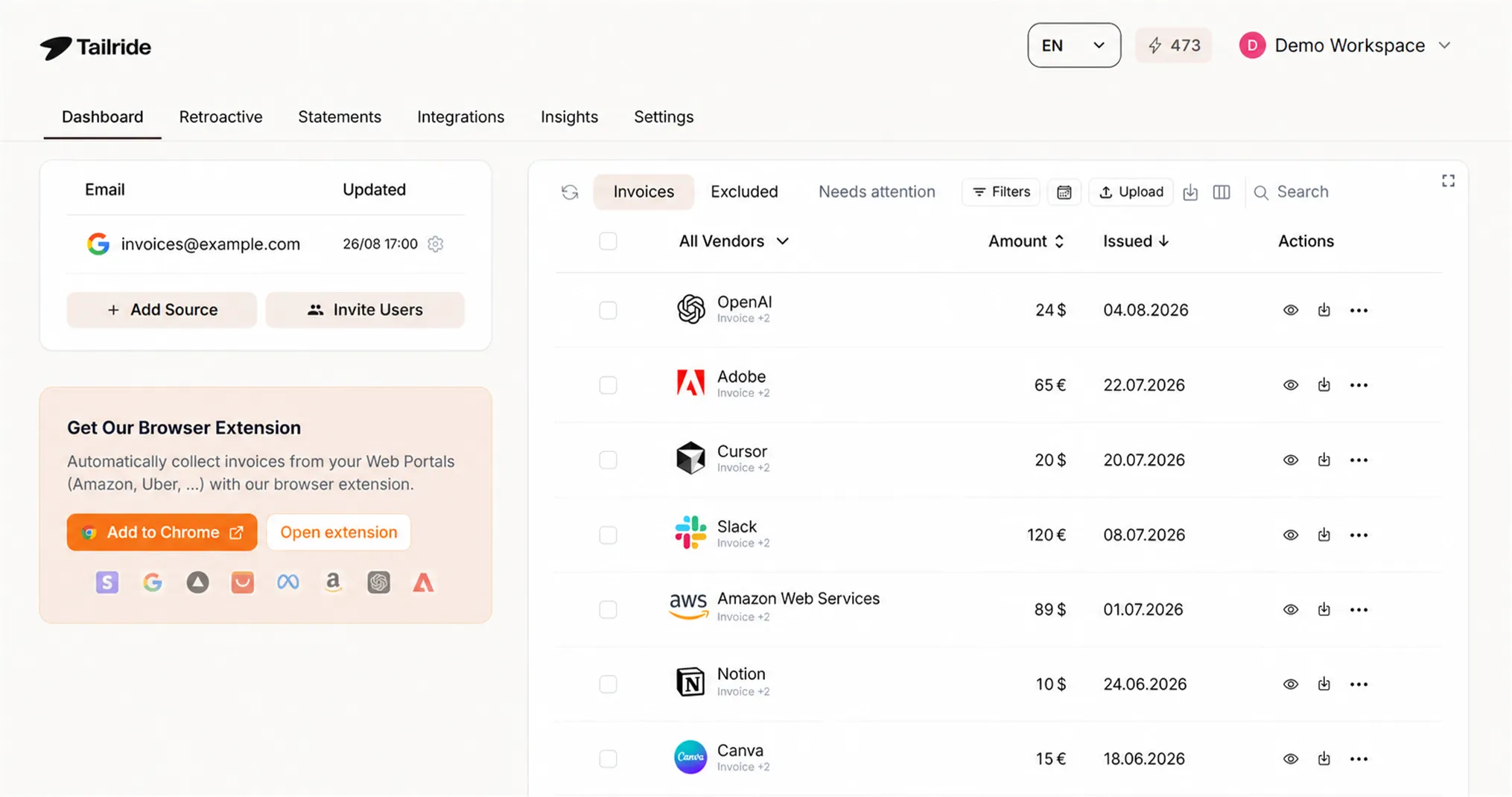
Tailride connects to Holded through the official API. It does not make the tax judgement for you - nothing does - but it changes the two conditions that make that judgement expensive: whether the document reached you at all, and whether you are looking at a total or at the actual contents.
Collection that does not wait to be fed. Inbox scanning connects to Gmail, Outlook or IMAP directly, so invoices are found where they land instead of depending on a forwarding rule someone has to maintain. Portal invoices come in through a browser extension that reads the page while you are logged in as normal. Nothing is stored in the cloud on your behalf, and a supplier switching on two-factor changes nothing. Receipts sent over WhatsApp or Telegram come in as well, which for expenses in the field is usually the only way they arrive at all.
Retroactive scanning. Point it at a mailbox and it rebuilds history for whatever range you choose. For a gestoría - a Spanish accounting and administration practice - taking on a client mid-year, that removes the request clients answer slowest.
Line-level reading with the tax per line. AI extraction runs to the line on every plan, not as a metered extra. Each line is coded to your own Holded chart of accounts with its own rate, so a document mixing 21% and 10% posts correctly instead of averaged. Base, cuota and total are checked against each other, and anything that does not reconcile comes up for review rather than posting on a guess.
The original stays attached. Every record keeps its source document, so when a review does raise a question about a particular ticket, the answer is one click away rather than a search through a year of email. Combined with the line detail, that is what turns the deductibility check from a task nobody does into one somebody actually can.
Pricing. Per document, never per user or per client - the full pricing is public. Free for 10 invoices a month, then from €12 a month billed annually for 900 a year. Practices running several clients should start at AP automation for accountants.
To be fair to Holded: if your suppliers email clean full facturas to the Inbox address and header data is all your bookkeeping needs, the native route is free, unlimited and entirely adequate. This layer earns its place when collection is the problem, when you need lines, or when a real share of your spend arrives as tickets.
A five-minute test on your own documents
Vendor claims settle nothing. Pull five documents out of your own archive and push them through whichever route you are considering.
-
A restaurant or fuel ticket under €400. Does the resulting record tell you whether your NIF is on it? Does it show the cuota separately?
-
An invoice with mixed rates, 21% and 10% on one document. Does each line carry its own rate, or is there one tax figure?
-
A photograph taken on a phone, slightly skewed, taken indoors. Did the total come back right? Check it by hand.
-
A scanned multi-page invoice. Did it fit under the size limit, and did every page get read?
-
An invoice you know exists only behind a supplier login. How did it get in? If the answer is "somebody downloaded it", that route has not been automated.
Then one question about the workflow rather than the documents: between this output and a posted, deductible entry, how many manual steps remain?
FAQ
Does Holded have an email address I can send invoices to?
Yes. Every company gets a unique Inbox address, and anything forwarded there lands in the Scanner queue for confirmation, the same place uploads go. Attachments up to 17 MB by email; manual uploads cap at 5 MB.
Is Holded's invoice scanner limited by plan?
No. The scanner is unlimited and included on every Holded plan at no extra cost, which is unusual in this category - Sage meters capture by transaction, Odoo consumes a credit per PDF, and Dext bills line items by credit.
Can I deduct the IVA on a ticket captured into Holded?
Only if the document itself carries your NIF, your name and address, and the cuota repercutida stated separately with the rate applied. A simplified invoice missing any of those is valid as a document but not deductible, and header-only capture will not tell you which kind you have.
Does Holded's OCR read line items?
Holded's documented extraction covers the supplier, the date and the amounts. For line-level detail with the tax rate taken per line you need a capture layer in front of it, such as Tailride.
Does Verifactu affect how I capture supplier invoices?
No. Verifactu applies to the software you use to issue invoices, not to how you receive and record incoming ones. The deadlines are 1 January 2027 for Impuesto sobre Sociedades taxpayers and 1 July 2027 for everyone else.
What happens to invoice capture when B2B e-invoicing becomes mandatory?
More of your supplier invoices will arrive as structured files rather than PDFs, and structured files need no OCR. The obligation phases in from October 2027 for businesses over €8 million in turnover and October 2028 for the rest, so most firms will run both formats side by side for a while.
How do I get historical invoices into Holded?
The native routes only handle what you put in front of them, one document at a time. Retroactive scanning pulls a chosen date range out of a connected mailbox and processes it through the same pipeline, which is the usual answer when you are backfilling a client's year.
The takeaway
Holded made a decision most of its competitors did not: capture is unlimited and free. That removes the cost question, and it leaves the substantive one exposed. Getting a document into Holded is easy. Knowing whether that document supports the deduction you are about to claim is the part nobody automates for you.
So the two questions worth asking are not about upload buttons. Are your invoices reaching you at all, or are some still sitting behind logins and in unforwarded inboxes? And when they arrive, does anything check the fields that make the IVA recoverable, while there is still time to ask the supplier for a better document?
If both answers are comfortable, the Inbox address is all you need and it costs nothing. If either one is not, that is the gap to close - and it is worth closing before the next modelo 303, the quarterly IVA return, rather than after it.
That is what we built Tailride for. Start free → · Holded integration → · Pricing →
Related guides
-
Features: automatic coding · AI processing · portals directory · online portals · retroactive scanning · inbox scanning · reconciliation
Sources
-
AEAT: facturas simplificadas (folleto de actividades económicas)
-
AEAT: Sistemas Informáticos de Facturación (SIF) y VERI*FACTU
This is general information for practitioners, not tax advice. Rates, thresholds and deadlines change, and the AEAT's own guidance is the authority. Confirm anything you plan to rely on.