Receipts for Tax: VAT Receipts, Deductions, and What to Keep (2026)
What a tax or VAT receipt needs, which receipts to keep and for how long, and whether you can claim without one - plus how to never lose one with Tailride.

Last updated: July 2026 · ~9 min read · Published by Tailride
A receipt is a small document, but it matters a lot at tax time. It is the proof that a purchase happened - the evidence behind a VAT reclaim or an expense deduction. Lose it, and you can lose the money it would have saved you.
This guide covers the parts that matter for tax: what makes a receipt valid, what a VAT receipt is and when you need one, whether you can claim without a receipt, how long to keep them, and the simplest way to make sure none go missing.
A quick note: this is general information, not tax advice, and the rules differ by country. Treat the figures below as examples of how VAT rules generally work, and confirm the current rules with your own tax authority or accountant before relying on them.
What is a tax receipt?
A tax receipt is simply a receipt you keep as evidence for tax - proof that you paid for something you are claiming as a business expense or reclaiming tax on. There is no special "tax receipt" document; it is an ordinary receipt doing double duty as a record.
It helps to be clear on the difference between a receipt and an invoice, because tax authorities are. An invoice requests payment; a receipt confirms that payment was made. For tax, what usually counts is proof that you paid, so a receipt (or a bank or card statement showing the payment) is what carries weight. If you want the distinction spelled out, see our guide to the difference between invoices and receipts.
What makes a receipt valid for tax
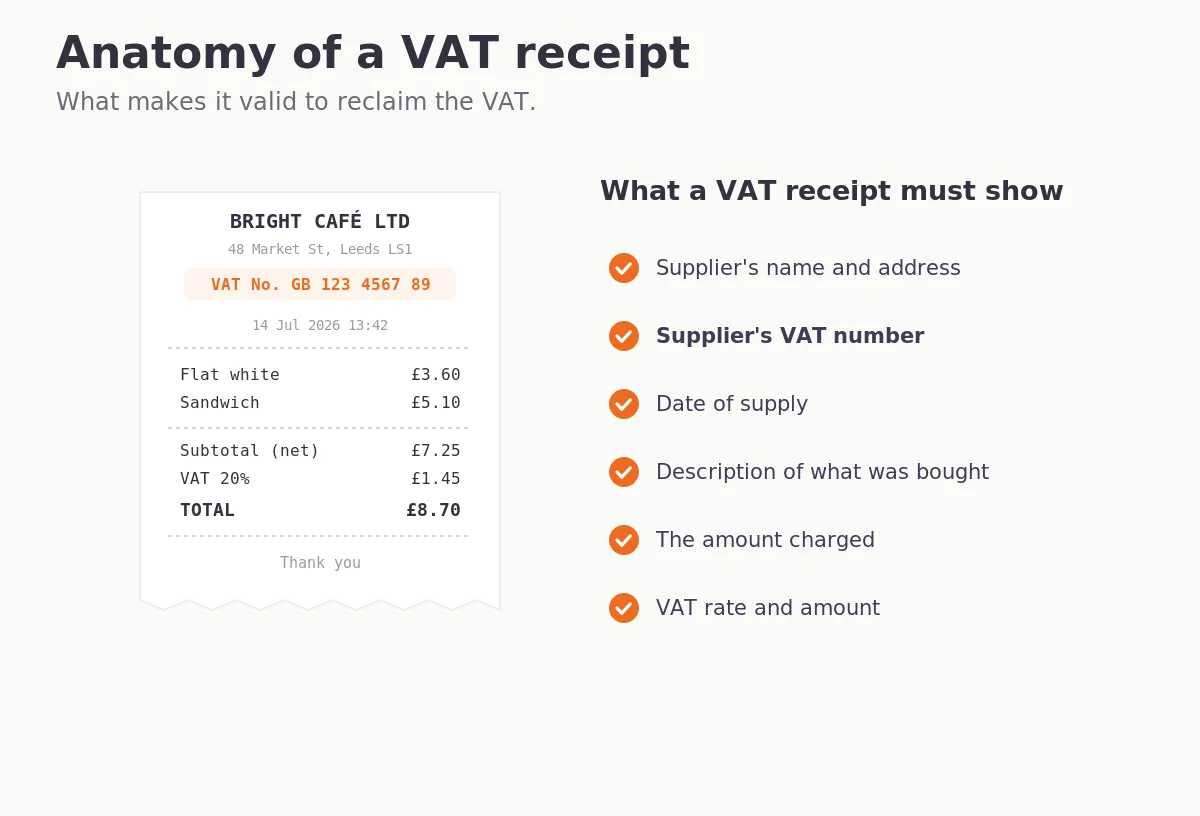
Whatever the country, a receipt that will hold up needs to show the basics of the transaction: the supplier's name, the date, the amount paid, a description of what was bought, and how it was paid. These are the core facts almost every tax authority expects to see.
For anything involving VAT, you also need the tax shown - the rate and amount - and, for a VAT reclaim, the supplier's VAT number. A total with no tax breakdown is fine as a spending record, but it will not let you reclaim the VAT.
The practical takeaway: a legible receipt with the supplier, date, amount, what it was for, and the tax is worth keeping. A faded till slip you cannot read in six months is not.
Keeping every receipt legible and in one place is exactly what Tailride does for you: it captures each one the moment it arrives and stores a clear, dated digital copy, so none fade or go missing before tax time. There is more on how that works further down.
VAT receipts: what they are and when you need one
If your business is registered for VAT, a VAT receipt (or VAT invoice) is what lets you reclaim the VAT you paid on a purchase. Put another way, the VAT on a receipt is only reclaimable when the receipt qualifies as a proper VAT document. Without a valid VAT invoice or receipt, the default position is simple: no document, no reclaim.
Across the EU the rules are broadly harmonised by the VAT Directive. A full VAT invoice shows both parties' details, the supplier's VAT number, a description of what was supplied, and the VAT rate and amount. For smaller purchases there is a lighter option: member states must allow a simplified invoice for amounts up to €100, which needs less - the supplier's identity, the date, a description, and the VAT amount (or the information needed to work it out) (European Commission: VAT invoicing rules). That is why the short receipt from a shop till can still support a reclaim - as long as it carries the supplier's VAT number.
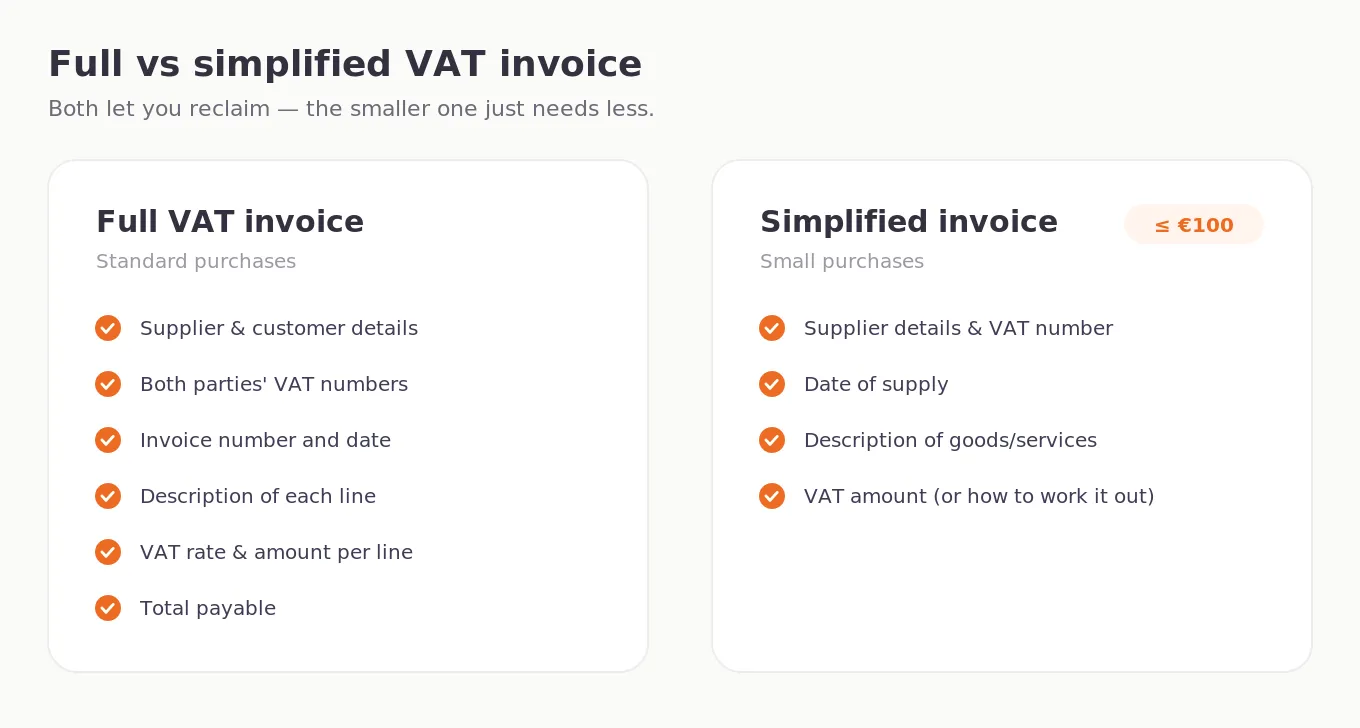
The thresholds and finer details vary from country to country, so a purchase that needs a full invoice in one place may sit under the simplified limit in another. When in doubt, ask for a full VAT invoice.
Can you claim without a receipt?
This is the question everyone asks, usually after the receipt has already vanished. The honest answer is: sometimes, within limits - but you should never plan on it.
To reclaim VAT, the starting point is the same almost everywhere: no valid VAT invoice or receipt, no reclaim. If a receipt is actually lost, some tax authorities will accept alternative evidence - a bank or card statement, an order confirmation, a supplier statement - but that is at their discretion, not a right. And a statement on its own does not show what was bought or how much VAT was on it, which is exactly what a reclaim needs.
For income-tax deductions, the picture is similar. You can sometimes claim a cost you are able to prove another way, but you generally still have to show the amount, the date, and the business purpose - and some categories, and some countries, insist on the receipt regardless. So a bank statement can back you up when a receipt is missing, but on its own it usually is not enough.
The safe conclusion is the simple one: keep the receipt.
Which receipts to keep, and for how long
Keep receipts for anything you claim as a business expense or reclaim tax on - supplier bills, subscriptions, travel, meals, equipment, professional fees, stock. If you are unsure whether a purchase is claimable, keep the receipt anyway; deciding later is easy, while recreating a lost receipt is not.
A few are easy to forget because they never arrive as paper: app-store and SaaS subscription receipts that only ever come by email; ad spend on Google, Meta and the like, which sits in a billing portal rather than your inbox; mileage, parking and tolls; bank and payment-processor fees; and one-off marketplace purchases from Amazon, eBay or similar. None of these are obvious at tax time - but each is claimable, and each has a receipt sitting somewhere you will need to have kept.
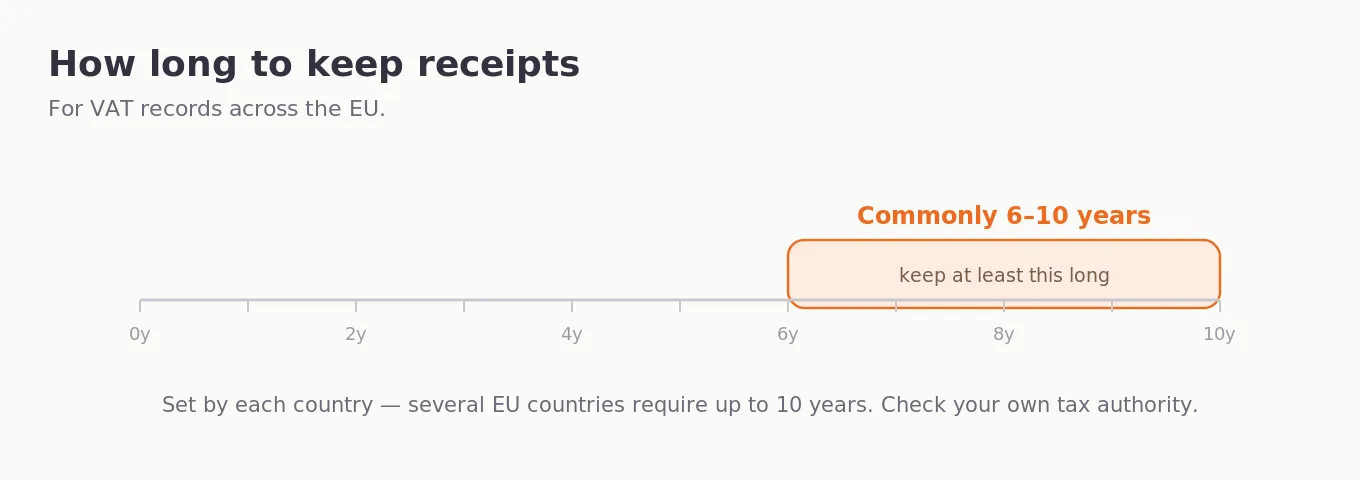
How long you keep them depends on where you file. Retention periods are set by each country and commonly run from six to ten years in the EU - several countries require up to ten years. Because the exact figure, and any recent changes to it, vary from place to place, confirm the current period with your national tax authority rather than assuming.
Digital copies count. Tax authorities across the EU accept clear scans or photos of receipts as records - you do not have to keep the fading paper, as long as the digital version is legible and complete. That single fact is what makes going paperless safe, and it is the foundation of the fix below.
Common receipt mistakes at tax time
Even people who keep their receipts make the same few mistakes:
-
Faded thermal receipts. Till receipts print on heat-sensitive paper that fades to blank within months. Photograph or scan them the day you get them, while they are still readable.
-
No VAT number on the slip. A receipt with no supplier VAT number will not support a VAT reclaim, however clear the total is. Check that it is there, or ask for a proper VAT receipt.
-
Throwing away the small ones. A simplified invoice for a small purchase still supports a reclaim; a low value does not make it worthless. A month of small receipts adds up to real, claimable spend.
-
Not noting the purpose. For meals and travel especially, tax authorities want to know why the cost was incurred and who it was for - the receipt alone does not say. Write it down while you remember.
-
Mixing personal and business cards. Paying for business costs on a personal card makes proof and reconciliation harder later. Keep the receipt regardless, and flag it as business.
-
Leaving it all to year-end. Receipts are hardest to find months after the fact. Capturing each one as it arrives is the difference between a clean claim and a scramble.
Most of these come down to the same root cause - receipts handled late, or not at all. Fix the capture, and the rest mostly takes care of itself.
The simplest way to never lose a receipt
Most missing receipts are not lost at tax time - they are lost the day they arrive. A paper slip fades in a wallet; an emailed receipt gets buried under other messages; a portal receipt sits behind a login no one remembers to check. By the time you need it, it is gone.
The reliable fix is to capture every receipt the moment it appears, and store the digital copy your tax authority already accepts. That is the core of what Tailride does: it connects to your inbox and pulls receipts and invoices automatically as they arrive, collects the ones locked behind vendor portals through its browser extension, and even takes a photo you snap on the go. Every one is read, organised, and kept - with the original attached - so when a VAT reclaim or a deduction is on the line, the evidence is already there.
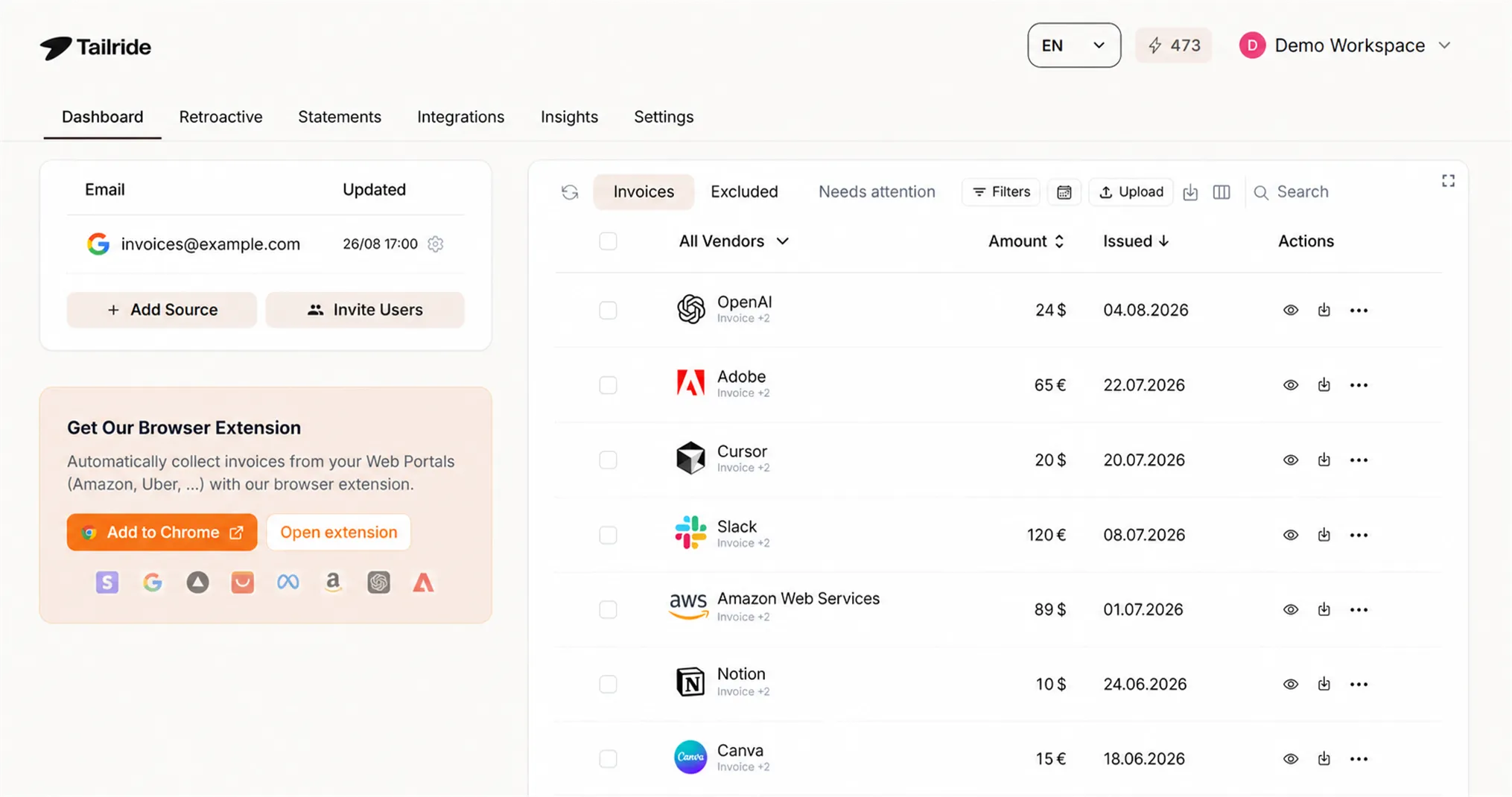
It also reads the detail off each receipt - supplier, date, amount, tax - so your records are not just a pile of files but a searchable set you (or your accountant) can actually use at year-end. If keeping receipts tidy is the wider goal, our guides to organising receipts and scanning receipts go further.
You can start free - 10 documents a month, no card - and stop losing the receipts that would have saved you money.
Frequently asked questions
What is a tax receipt?
It is an ordinary receipt kept as evidence for tax - proof you paid for something you are claiming as a business expense or reclaiming tax on. There is no separate "tax receipt" document; a normal receipt showing the supplier, date, amount, description, and tax does the job.
Can I reclaim VAT without a receipt?
Usually not. To reclaim VAT you generally need a valid VAT invoice or receipt showing the supplier's VAT number. If one is actually lost, some tax authorities may accept alternative evidence such as a bank statement at their discretion, but that is a fallback, not a right.
What is a simplified VAT invoice for small amounts?
For purchases up to €100, EU rules require suppliers to be allowed to issue a simplified invoice with fewer details - the supplier, the date, a description, and the VAT amount. It still supports a reclaim, provided the supplier's VAT number is shown. National thresholds and details vary, so check your country.
Is a bank or card statement enough on its own?
It helps prove a payment was made, and can be a backup when a receipt is missing, but on its own it usually is not enough - it does not show what was bought or the tax, which is exactly what a VAT reclaim needs.
Are digital or photo receipts accepted for tax?
Yes. Tax authorities across the EU accept clear digital copies or photos of receipts, so you can go paperless as long as the image is legible and complete.
How long do I have to keep receipts?
It depends on where you file. Across the EU it is commonly six to ten years for VAT records, with several countries requiring up to ten. Confirm the current period with your own tax authority.
The takeaway
For tax, a receipt is only useful if you still have it and can read it. Know what makes one valid, keep everything you claim on, hold them for as long as your tax authority requires, and - the part that trips most people up - capture each one before it disappears. Do that, and receipts stop being a drawer of paper you dread and become a record that quietly does its job.
This article is general information, not tax or legal advice. Rules vary by country and change over time; confirm anything you plan to rely on with your tax authority or a qualified accountant.
Related guides
Sources: European Commission - VAT invoicing rules · EUR-Lex - The EU's common system of VAT (Directive 2006/112/EC)
