Will AI Replace Accountants in the Next Few Years?
Will AI replace accountants? The data says no - but the job is changing fast. What's actually at risk, and what isn't.

For worried professionals who anxiously clicked this link: No. AI isn't replacing accountants - but it is automating accounting tasks, fast. Manual data entry, transaction processing, and chasing down missing paperwork are going first. What's left, and what's growing, is the judgment: advising clients, weighing grey areas, signing off. The likely outcome isn't accountants out of work. It's accountants doing less typing and more advising.
It helps to split "will AI replace accountants?" into the two questions people usually mean by it: will the profession survive, and will my own job look the same in five years? The profession is in no real danger. The day-to-day is another matter.
The numbers, before the opinions
| What the data says | Figure | Source |
|---|---|---|
| Accountant & auditor jobs, 2024–2034 | +5% (faster than average) | U.S. BLS |
| Projected openings per year | ~124,200 | U.S. BLS |
| Bookkeeping & payroll clerk roles | Among fastest-declining | WEF, 2025 |
| Firms using AI (2024 → 2025) | 9% → 41% | CPA.com / Thomson Reuters |
The same split runs through every row: the accountant numbers climb while the clerk numbers fall. Most of the confusion about AI and accounting comes from blurring those two lines into one.
Will AI replace accountants? The short answer
No - not in any timeframe worth planning your career around. The U.S. Bureau of Labor Statistics projects employment of accountants and auditors to grow about 5% from 2024 to 2034, faster than the average for all occupations, with roughly 124,200 openings a year. A profession on the verge of being automated away does not get a "faster than average" label from labor economists.
The catch sits one level down: the same automation that's expanding the accountant's role is thinning out the clerical layer beneath it.
Which accounting jobs are actually at risk?

"Accounting" isn't one job - it's a ladder, and AI is climbing it from the bottom.
The World Economic Forum's Future of Jobs Report 2025 ranked accounting, bookkeeping, and payroll clerks among the fastest-declining roles over the next five years. Note the word clerks. The roles under pressure are built almost entirely on repeatable, rules-based tasks. The roles that are growing - accountants, auditors, advisors, controllers - are built on judgment.
| Most exposed to AI | Most protected from AI |
|---|---|
| Manual data entry | Professional judgment in grey areas |
| Invoice & receipt processing | Audit opinions and sign-off |
| Basic categorization & coding | Tax and advisory strategy |
| First-pass reconciliation | Client relationships and trust |
| Manual report assembly | Oversight of the AI itself |
The more of your week sits in the left column, the more exposed you are. Most qualified accountants spend most of theirs on the right - which is exactly why the profession keeps growing while the clerical roles thin out.
The prediction that aged badly

Fear about this isn't new. Back in 2013, an Oxford study by Carl Frey and Michael Osborne modelled which jobs computers could automate - and The Economist, citing their work, put the probability for accountants and auditors at a terrifying 94%. For a decade, that number anchored every "robots are coming for your job" headline.
More than ten years on, U.S. accounting employment hasn't collapsed. It grew, and the BLS expects it to keep growing through 2034.
The 94% figure wasn't wrong about the technology. It was wrong about the job. What it really measured was how many accounting tasks a computer could theoretically do, and then it pinned that number on the whole profession. But a job is more than the sum of its tasks. Strip out the routine ones and what's left is the judgment, the responsibility, and the client trust the model never came near - and the work reorganises around those.
It's a handy rule for reading any AI-and-accounting headline: ask which tasks are actually moving, not whether "accountants" are finished.
What can AI actually do in accounting today?

Quite a lot - and it's the boring, time-consuming half of the job.
| AI handles this well today | This still needs a human |
|---|---|
| Capturing invoices & receipts from inboxes and portals | Deciding non-standard accounting treatments |
| Extracting & structuring data (amounts, tax, line items) | Owning legal and regulatory sign-off |
| Categorizing and coding against your rules | Advising clients through real decisions |
| First-pass reconciliation and transaction matching | Catching when the AI is confidently wrong |
| Duplicate and anomaly detection | Judgment under genuine ambiguity |
Everything in the left column is high-volume, low-judgment work - the stuff that eats an accountant's hours without ever touching their expertise. For most people in the profession, handing it off is a relief, not a threat.
In practice this shows up as a stack rather than one magic tool. One layer captures documents and turns them into clean, coded data; your accounting platform holds the books; a general assistant helps you draft and explain. Tailride lives in that first layer - it reads invoices and receipts straight from inboxes and vendor portals, structures them with AI, and feeds whatever ledger you already run.
| Job to be done | What it covers | Example tools |
|---|---|---|
| Capture & extract | Pull invoices and receipts in, read and code them | Tailride |
| Keep the books | Ledger, tax, reporting | QuickBooks, Xero, Sage, DATEV |
| Reconcile | Match transactions to invoices | Tailride, your bank feed |
| Draft & analyse | Summaries, client emails, first-pass commentary, and workbook review | ChatGPT, Claude, Microsoft Copilot |
For a closer look at the general-assistant layer, see how accountants can work with ChatGPT and Claude while keeping financial decisions under human review.
None of these replace the accountant. They clear the desk so the accountant can get to the work in the right-hand column.
The data entry was never the job. AI is just making that impossible to ignore.
What AI can't replace

There's a hard ceiling on what today's AI can do, and it sits precisely where an accountant's value lives.
Professional judgment in ambiguity. Accounting is full of "it depends" - revenue recognition on an odd contract, the right treatment for an unusual transaction, materiality calls. These weigh context that isn't written down anywhere a model can read.
Accountability and sign-off. A model can draft a financial statement. It cannot be responsible for one. Audit opinions, tax filings, and certifications carry legal liability that a named human has to carry, and when something goes wrong the regulator comes for that person - not the software.
Advisory and trust. Clients don't pay their accountant only to be right - they pay to be understood and guided through decisions with money and risk attached. That relationship is human by definition.
Judgment about the AI itself. As more work is automated, checking the automation becomes a skill in its own right. Someone has to know when the model is confidently wrong - and that someone is an accountant.
So what actually happens in the next few years?
If AI isn't replacing accountants, what is it doing on a two-to-five-year horizon? Mostly this: it's being adopted very fast, and it's rewriting the day-to-day work while the job title stays the same.
The pace is striking. AI use among tax and accounting firms more than quadrupled in a single year - from roughly 9% to 41% - and by 2025 about 72% of firms were using AI at least weekly. Nearly eight in ten firms expect significant generative-AI integration by 2027. This isn't a someday technology; it's a this-budget-cycle one.
A realistic timeline looks like this:
-
Right now (2026): AI reliably handles capture, extraction, coding, and first-pass reconciliation. Early adopters have already deleted most of their manual data entry; laggards still key it by hand.
-
Next 2–3 years: Automation becomes table stakes - clients and partners expect it. The edge shifts from whether you automate to how well you supervise the automation and convert the freed-up hours into advisory work. The bookkeeping-clerk tier thins out noticeably.
-
Five years and beyond: AI takes on more analytical drafting - variance commentary, first-pass forecasts, anomaly investigation - but a human still reviews, decides, and signs. The accountant's job description simply has more "advisor" in it and less "processor."
Picture the junior who used to lose the first week of every quarter to keying a few hundred supplier invoices. By 2026 that week is simply gone. The interesting question - for them and for their firm - is what fills it.
Nowhere on that timeline is there a year when accountants stop being needed. The work keeps pointing the same direction: away from the keyboard, toward the call with the client.
The case for worry (because it isn't all reassurance)
There's a serious counterargument here, and waving it away would be its own kind of spin. A few reasons the "this time is different" camp might be right:
-
The pace is unprecedented. Quadrupling adoption in a year is not how the calculator or the spreadsheet rolled out. Faster change leaves less time to retrain and reposition.
-
The clerk tier is genuinely shrinking. "The role evolves" is cold comfort if your current job is the data entry. Real people in clerical roles will have to climb the ladder, and not everyone will make the jump.
-
AI keeps climbing. Each model generation does a little more of what used to count as judgment. The boundary between "AI can't do this" and "AI can now do this" keeps moving, and the safe ground narrows.
-
Complacency is the real exposure. The accountants who get hurt won't be replaced by AI - they'll be out-competed by other accountants who adopted it first.
None of this points to the profession dying. It points to standing still as the real risk. The threat is genuine - it's just aimed at tasks and habits, not at the existence of the job.
Will AI replace bookkeepers?
This is the sharper version of the question, and it deserves a straight answer.
The bookkeeper's reality: Pure data-entry bookkeeping - just moving receipts into software - is the most automatable work in the entire stack, and it's what AI is best at today. That task is dying. But the role is being rebuilt one rung up: the bookkeepers thriving in 2026 have shifted from doing data entry to managing the systems that do it, reviewing exceptions, and advising small-business clients on cash flow and process.
The task is genuinely dying. The role, for anyone willing to climb a rung, is doing fine.
How should accountants adapt?

The accountants who come out ahead tend to share one habit: they reach for the tools early, then spend the hours they free up on work that pays better.
-
Automate the busywork on purpose. Every hour spent keying or chasing invoices is an hour not spent advising. Hand it to software deliberately - Tailride, for instance, pulls every invoice and receipt out of your inbox and vendor portals and codes it for you.
-
Move toward advisory. Cash flow, forecasting, tax strategy, systems design - the work clients value most is the work AI is furthest from doing.
-
Become the AI's editor. Learn to configure, supervise, and sanity-check automated workflows. Oversight is a billable skill.
-
Lean into the relationship. Trust, communication, and judgment are your moat. Invest in them.
What it means for accounting firms
There's a telling gap in who's already moving: roughly 76% of large firms view AI adoption positively, against only 38% of the smallest firms. That gap is an opportunity and a warning at once.
For a firm, this is a margin and capacity question. Automating capture and data entry across a whole client base pulls senior staff off low-value processing and frees them for advisory work that bills at a higher rate - or simply lets the firm take on more clients without hiring. Over the next few years the firms that pull ahead will be the ones whose people spend the least time keying data, regardless of team size. A micro-firm that sits it out isn't really saving money; it's handing that ground to a competitor who automated.
Where Tailride fits in
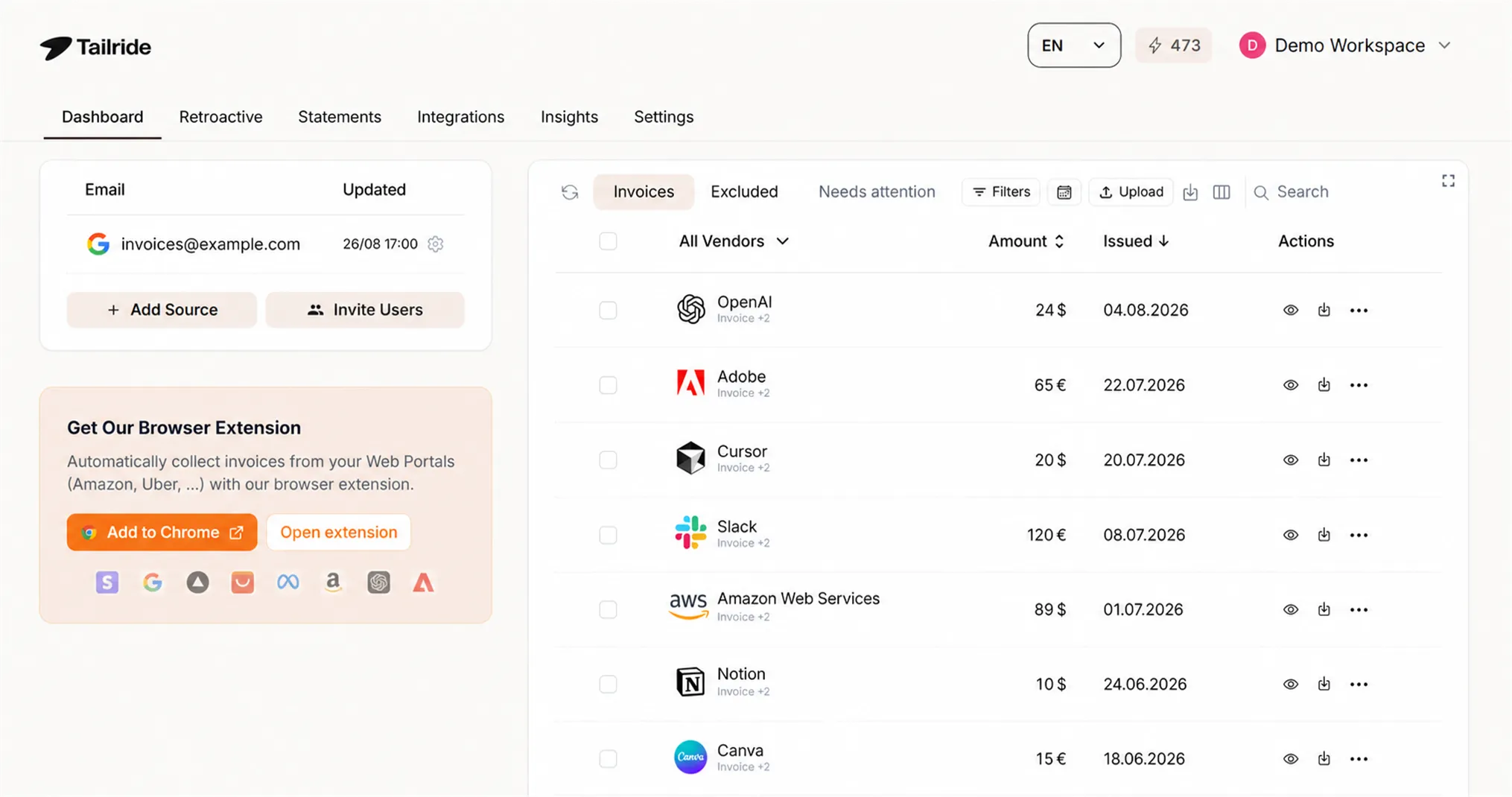
If the whole strategy is "automate the data entry and move up the value chain," that first step is exactly what we built Tailride to do. It's the capture-and-extraction layer of the stack above - the unglamorous part that makes everything else possible - and it runs on the same class of large language models behind ChatGPT and Google Gemini, pointed at invoices instead of essays.
Here's what it actually does:
-
Finds the invoices for you. Connects to Gmail, Outlook, and IMAP and scans your inbox - and your colleagues' - for every invoice and receipt, including ones buried in attachments or behind links.
-
Pulls from vendor portals. A Chrome extension grabs invoices from services that never email them - Amazon, Meta Ads, ChatGPT, and 20+ others - in a single click.
-
Reads and codes with AI. The AI processing layer extracts every field and applies the rules you set, so the data lands clean.
-
Reconciles automatically. Upload a bank statement and Tailride matches transactions to invoices and surfaces whatever's missing.
-
Delivers it where the books live. Pushes coded records straight into QuickBooks, Xero, DATEV, Business Central, Google Drive, or Sheets.
For accounting firms, AP automation built for accountants runs all of this across every client from one master dashboard - the practical route to freeing senior staff for advisory work. None of it replaces the accountant; it clears the desk so they can spend their time on the work an LLM can't sign off on.
The data entry is getting automated either way - ** start with the part that frees up your week.** Or see how Tailride works for accountants.
The bottom line
Will AI replace accountants? No - but it's quietly retiring the data-entry job that used to hide under the title. The profession is growing; the work inside it keeps shifting toward judgment and advice. The accountants who'll do best over the next few years aren't waiting to see how it shakes out. They've already handed the typing to software and gone back to the part of the job clients actually pay for.
FAQ
Will AI replace accountants?
No. AI is automating specific accounting tasks - mainly data entry, transaction processing, and reconciliation - but not the profession. The U.S. Bureau of Labor Statistics projects accountant and auditor employment to grow about 5% from 2024 to 2034, faster than average. Judgment, advisory work, and sign-off responsibility still require human accountants.
Will AI take over accounting entirely?
No. AI is taking over the repetitive, rules-based parts of accounting, but it cannot own professional judgment, regulatory accountability, or client relationships. The realistic outcome is a hybrid model: AI handles high-volume tasks, accountants handle interpretation, strategy, and oversight.
Will accountants be replaced by AI in the next 10 years?
Unlikely. Over the next decade the role will change more than it shrinks. Clerical and data-entry tasks will be largely automated, while demand for advisory, audit, and judgment-based work grows. Accountants who adopt AI tools will be more productive, not unemployed.
Will AI replace bookkeepers?
Pure data-entry bookkeeping is the most automatable work in accounting and is being replaced fastest. But the bookkeeping role is shifting toward managing automation, reviewing exceptions, and advising clients - tasks that remain human.
What parts of accounting will AI automate first?
The highest-volume, lowest-judgment tasks: capturing invoices and receipts, extracting and coding data, categorizing expenses, first-pass bank reconciliation, and duplicate or anomaly detection.
How fast are accountants actually adopting AI?
Very fast. AI use among tax and accounting firms jumped from around 9% to 41% in a single year, roughly 72% now use AI at least weekly, and nearly 80% expect significant generative-AI integration by 2027. Adoption - not whether the technology works - is now the main thing separating firms.
Is accounting still a safe career in 2026?
Yes - with a caveat. The profession is growing, but the value is moving up the ladder. Careers built on manual processing are at risk; careers built on advisory, judgment, and managing automation are in strong demand.
Sources: U.S. Bureau of Labor Statistics, Occupational Outlook Handbook - Accountants and Auditors (2024–2034 projections); World Economic Forum, Future of Jobs Report 2025; Frey & Osborne, "The Future of Employment" (Oxford, 2013), as cited by The Economist; CPA.com / Thomson Reuters 2025 AI-in-accounting adoption data.
