
Dext Alternatives for UK Accounting Firms (2026)
Credit-gated line items, Fetch that breaks on 2FA, collection that starts only today. Seven Dext alternatives for UK practices, Tailride first.

Last updated: July 2026 · ~11 min read · Published by Tailride
Dext is the default in a lot of UK practices, and for good reason: the mobile app is the best in the category, the Sage and FreeAgent integrations are mature, and clients who photograph paper receipts get on with it without training. Nothing here argues that it is a bad tool.
What tends to push firms to look around is narrower than that. Three things come up again and again: line-item extraction is metered by credits, Fetch connections keep dropping as suppliers turn on two-factor authentication, and collection only ever starts from the day the client is set up. Under Making Tax Digital, that third one has stopped being merely annoying.
Short answer
Look at an alternative if you are paying for line-item credits every month, spending time repairing Fetch connections, or need a client's back catalogue of invoices rather than everything from today onwards. Stay with Dext if paper receipt capture on a phone is the core of your workflow, or if you rely on its expense reports, mileage and approval flows.
The detail behind that:
-
On Dext, line-item extraction is credit-metered: 5 credits a month included, then billed on top. Bank statements and supplier statements work the same way.
-
Fetch pulls supplier bills using credentials stored in the cloud, so connections break when a supplier adds 2FA or redesigns its site.
-
Dext collects what is forwarded to it from setup onwards. Invoices already sitting in a client's inbox stay there.
-
Dext's entry plan is $31.50 a month for 250 documents and 5 users, with no free tier. Practice plans start at a 10-client minimum.
-
Tailride connects to Gmail or Outlook directly, scans years of history retroactively, fetches portals through a browser extension that survives 2FA, and includes line items and bank matching on every plan. Free for 10 invoices a month, then from $19.
Why UK practices start looking around
Line items are metered, and line items are the job
Dext's Business plan includes five line-item credits a month. After that, each document you need broken into its individual lines is billed on top.
For a practice, that is the wrong shape. Line-level detail is not an occasional extra - it is what lets you code a builder's merchant invoice across materials, plant hire and delivery, and it is what lets you apply the right VAT treatment to each line rather than to the whole bill. A single invoice can carry 20% standard rate on some lines and 0% or 5% on others, and construction work under the domestic reverse charge does not follow the header at all.
If the tool that reads the document does not split it, someone in your team does.
Fetch connections and two-factor authentication
Fetch is the feature that collects supplier bills automatically, using credentials held in the cloud. It works until the supplier changes something. Reviewers consistently report connections dropping when a provider adds two-factor authentication, and UK suppliers and banks have been adding it steadily under strong customer authentication rules.
The result is a maintenance task nobody budgeted for: someone re-authenticating connections each month, and documents quietly not arriving in the meantime.
Collection starts the day you switch it on
This is the one that matters most for a practice taking on new clients. Dext processes what is submitted to it from the moment the account is live. The eighteen months of invoices already sitting in the client's inbox are not part of that.
So onboarding involves asking the client to dig out historical documents, which is the request they are slowest to answer. Meanwhile the ledger has gaps, and under MTD those gaps are not just untidy.
The cost shape for a small client
Dext's entry plan runs $31.50 a month ($25.21 billed annually) for 250 documents and five users, with a 14-day trial and no free tier. A client sending you 40 invoices a month pays for 250. Practice pricing sits at $17.70–19.20 per client per month with a ten-client minimum, which is fine at scale and awkward when you are adding your third client.
What MTD expects from whatever you use
Making Tax Digital is the reason the collection question has teeth in the UK, and it is worth being precise about what it asks for.
MTD for VAT requires that records are kept digitally, that the software is HMRC-compatible, and that data moves between systems through digital links rather than by hand. HMRC has been explicit that copying and pasting or retyping figures between systems breaks the link, and the penalty for failing to keep digital records or maintain digital links runs to up to £3,000 (HMRC guidance summarised here).
From April 2026, MTD for Income Tax Self Assessment applies to sole traders and landlords with qualifying income above £50,000, dropping to £30,000 in April 2027. Late submissions attract penalty points, with a £200 charge once you cross the threshold, though the first year of ITSA has a grace period for quarterly updates.
For a capture tool, three practical consequences follow:
-
The chain has to be unbroken. Document in, data out, into the ledger, without a manual re-key in the middle. A tool that exports a spreadsheet for someone to import by hand is the thing MTD is aimed at.
-
The record has to be complete. Invoices that never got forwarded are missing records, not just missing tax relief.
-
The original has to be retained. VAT records, including invoices, are kept for at least six years, and a digital copy is acceptable as long as it is legible and complete.
None of that requires any particular vendor. It does rule out workflows that end in a CSV and a copy-paste.
Seven Dext alternatives for UK practices
Positioning summaries, not spec sheets - capabilities and prices move, so confirm anything decisive on the vendor's own page.
1. Tailride
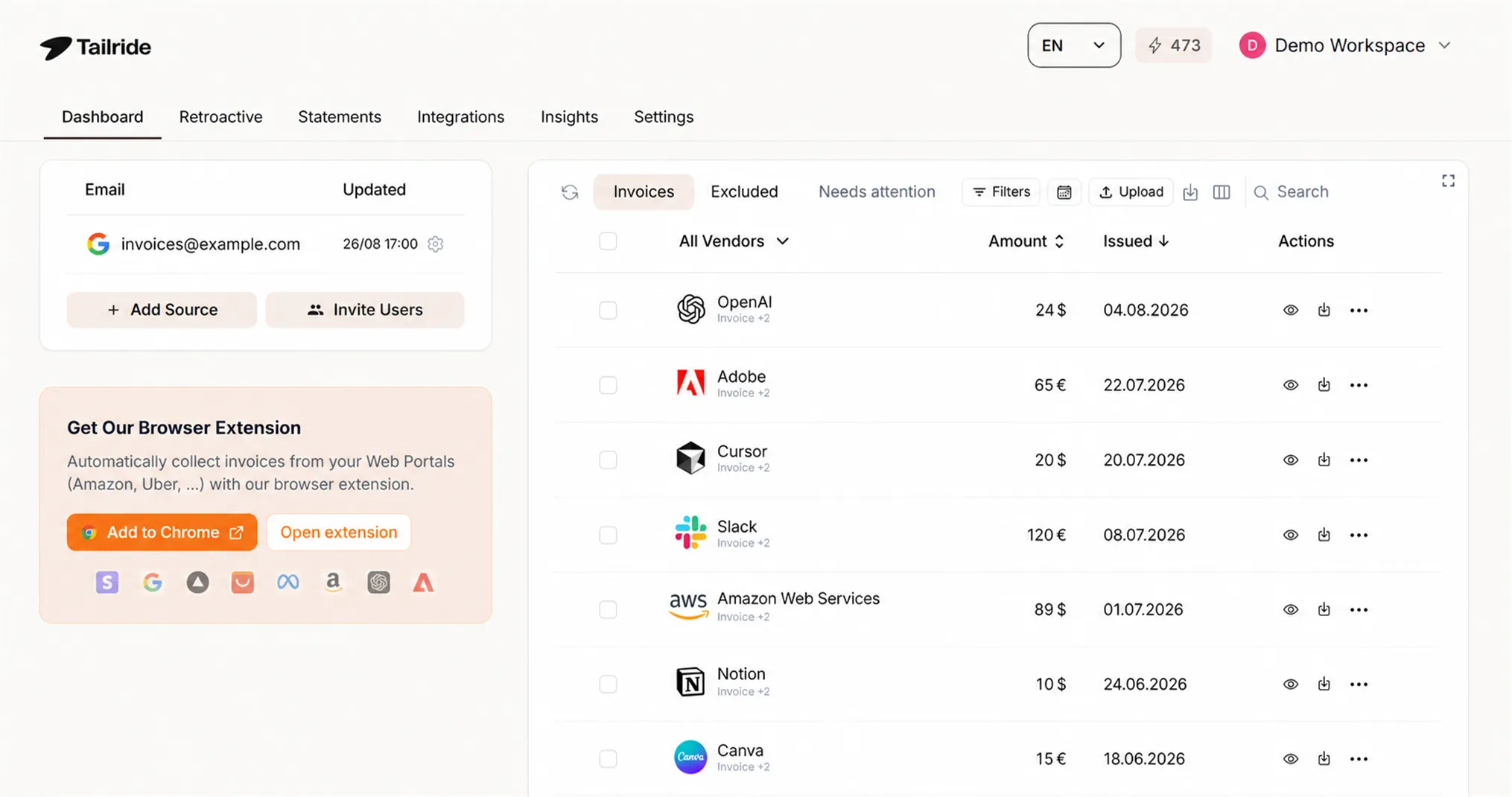
Tailride is built around collection and coding rather than receipt photography. It connects directly to a client's Gmail or Outlook, finds invoices without anyone forwarding them, and scans existing history retroactively, so a new client's back catalogue rebuilds itself instead of arriving in dribs and drabs.
Supplier portals are handled by a browser extension that runs inside your own logged-in session, which is why two-factor authentication does not break it. It ships with 100+ portals and can be taught any other, including intranet systems no cloud connector can reach.
Every document is read to the line level on every plan, with no credit metering, and each line is coded to the chart of accounts with its own tax rate - the mechanics are covered on our automatic coding page. Hand-off goes to Xero, QuickBooks, Odoo, Business Central, sevDesk, Lexware Office and e-conomic, plus CSV and an API. Bank reconciliation is included on every plan rather than metered.
Practices get accountant accounts with a master dashboard, volume pricing and a separate dashboard per client, with no minimum client count. There is more on the workflow side on our AP automation page.
Pricing: free for 10 invoices a month, then $19 for 75, $49 for 350, $99 for 750 and $199 for 1,500, with roughly two months free annually.
Best for: practices whose clients receive invoices by email and from portals, and who want line items and history without per-document extras.
2. Hubdoc
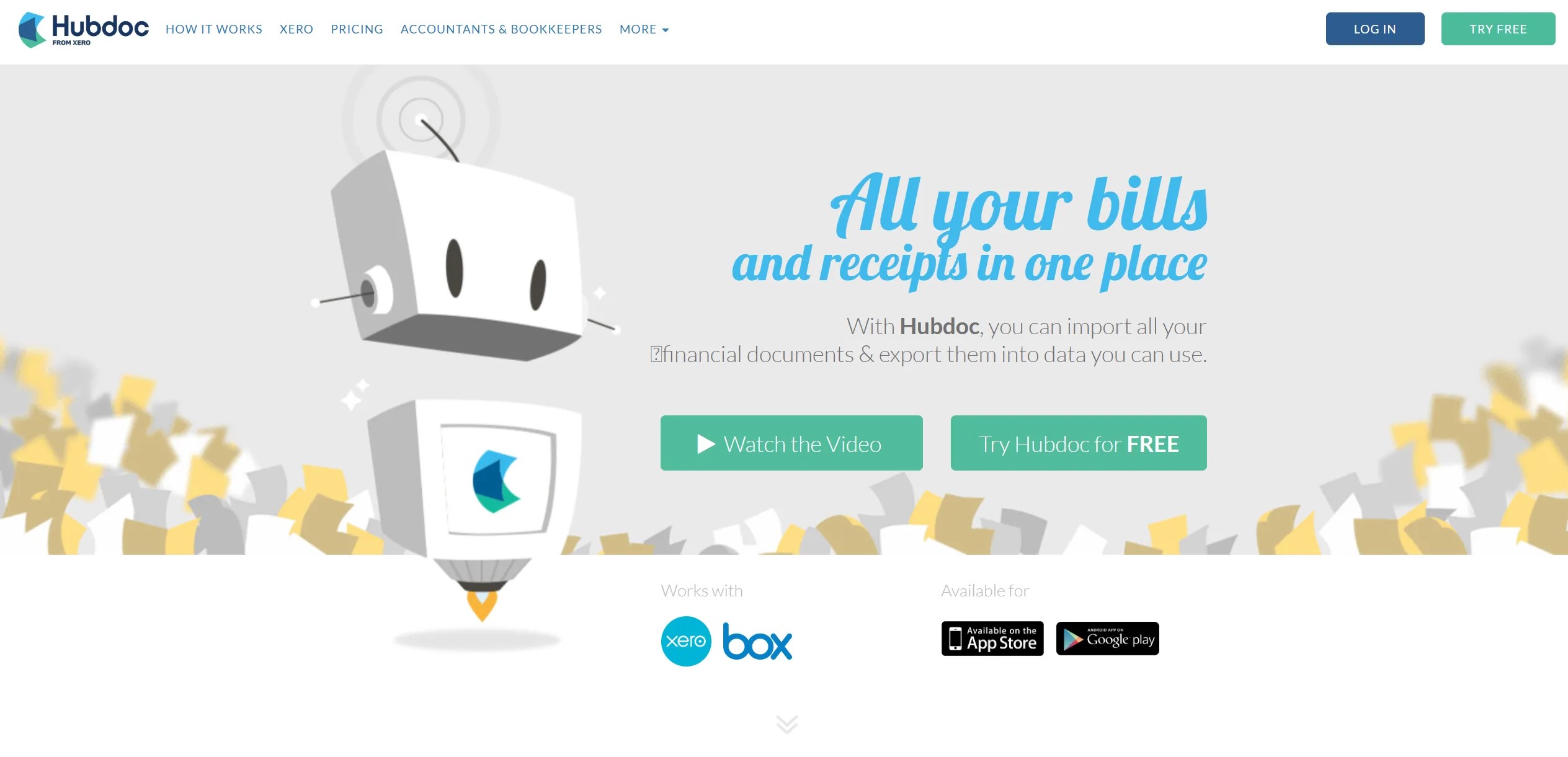
Free with every paid Xero plan, which makes it the obvious first stop for a Xero practice. The trade-off is depth: Hubdoc captures the header - supplier, date, total - and not line items, and its automatic fetch connections were retired in 2022 in favour of a small set of direct APIs. Fine as a document store attached to Xero, thin as a coding tool. See Tailride vs Hubdoc.
3. AutoEntry
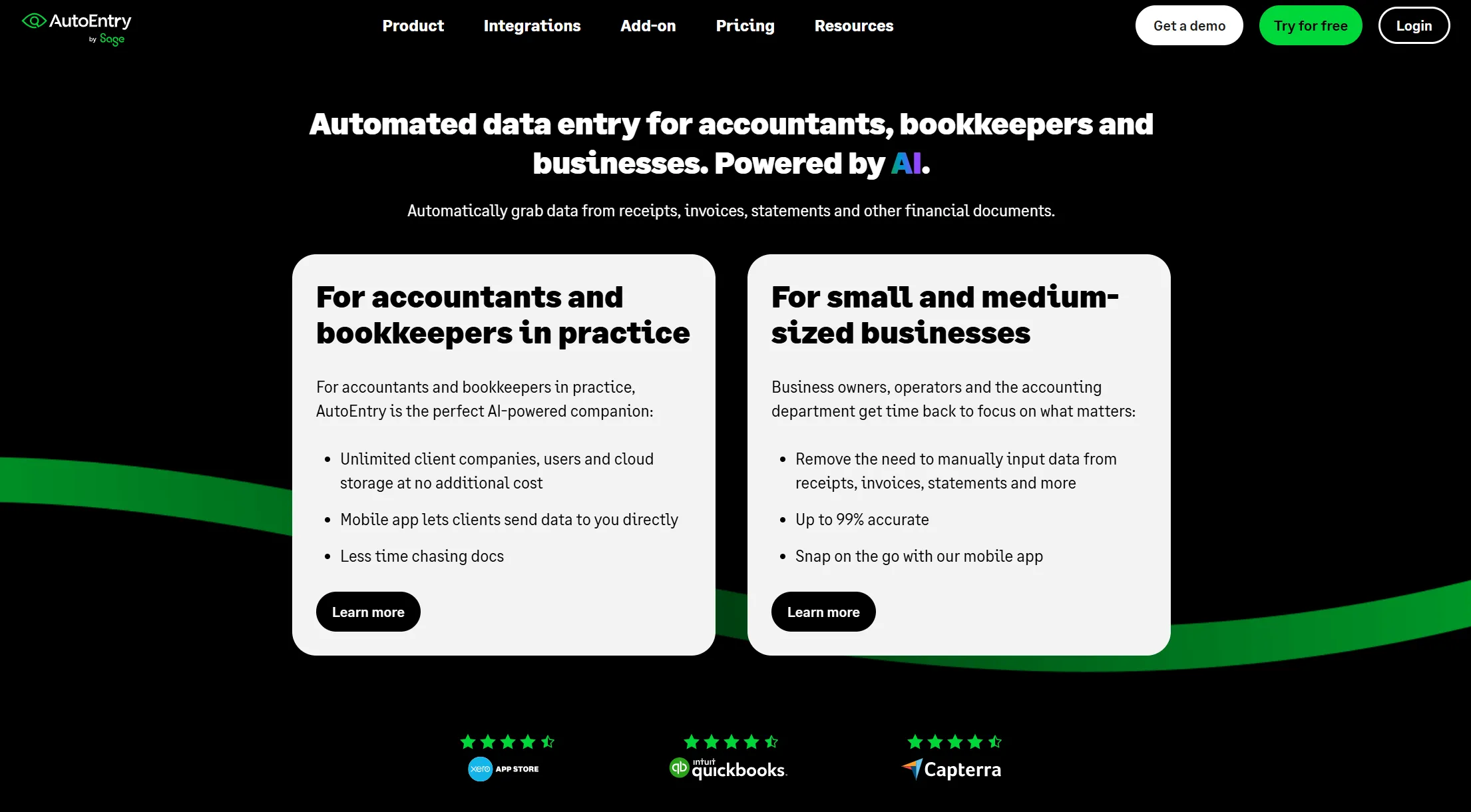
Sage-owned since 2019 and a natural fit for Sage practices. It captures full line items including description, unit price and quantity, but runs on credits, and line-item documents draw at roughly twice the standard rate with bank statements higher still. Predictable if your volumes are steady, less so if they spike.
4. Lightyear
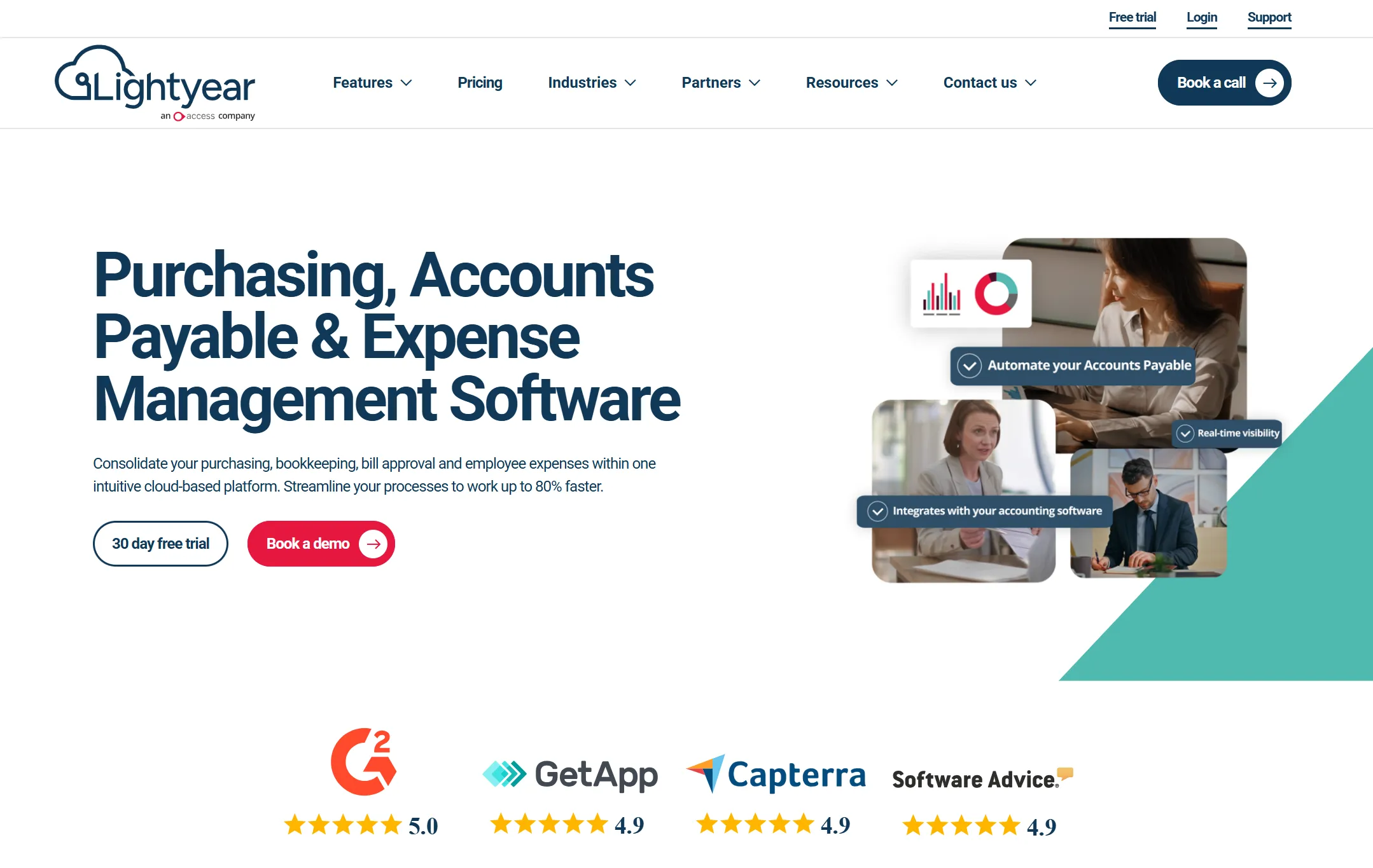
A purchasing and AP platform rather than a capture tool, with line-item and SKU-level extraction, purchase order matching and approval workflows, integrating with Xero, Sage, QuickBooks, AccountsIQ and others. Pricing starts around £130 a month, which places it with larger finance teams rather than a practice's smaller clients.
5. Datamolino
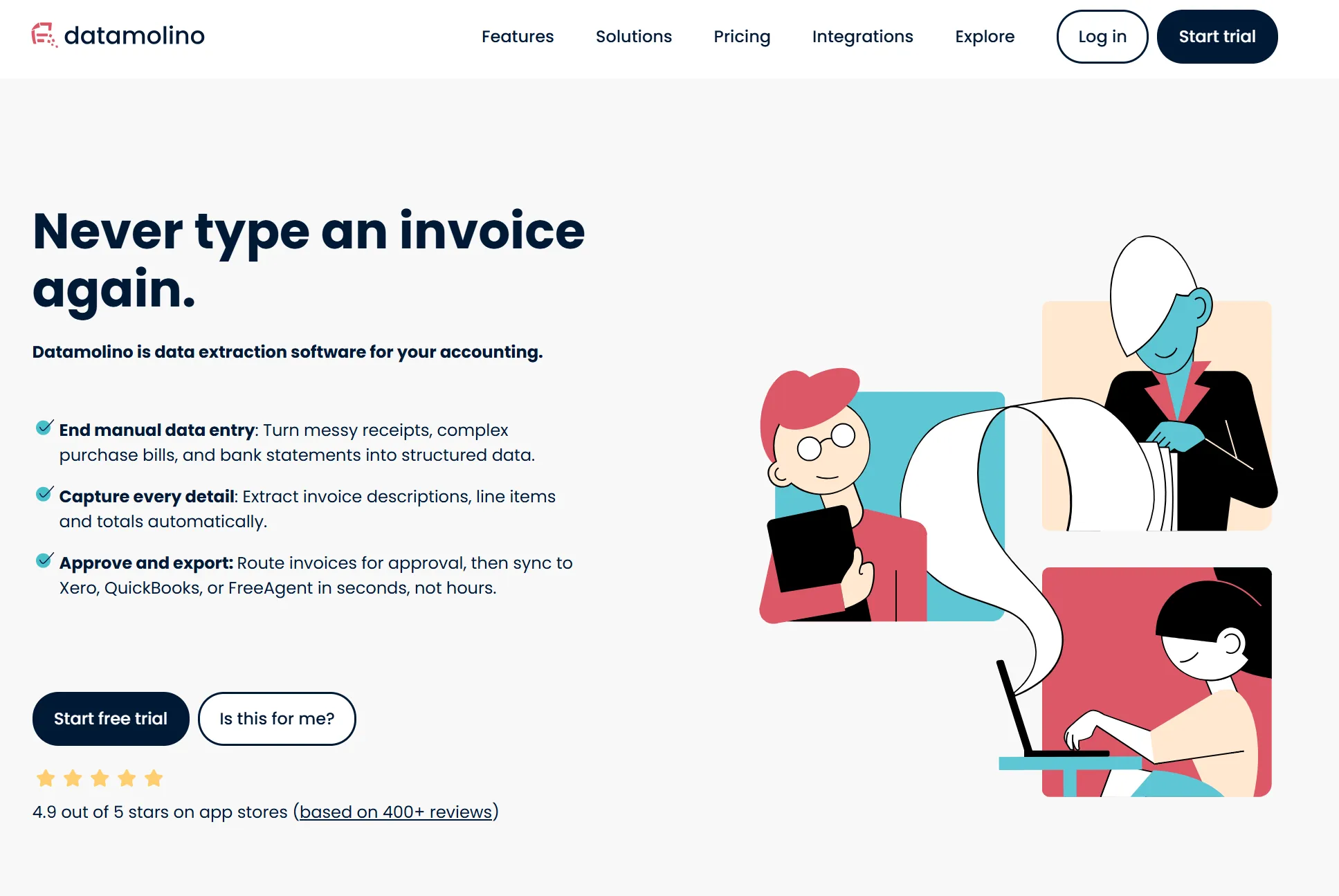
A long-running capture tool aimed at accounting practices, with Xero, QuickBooks and Sage hand-off, multi-client handling and simpler pricing than the credit-based tools. Built around Latin-script documents, which is worth checking against your client base.
6. Receiptor
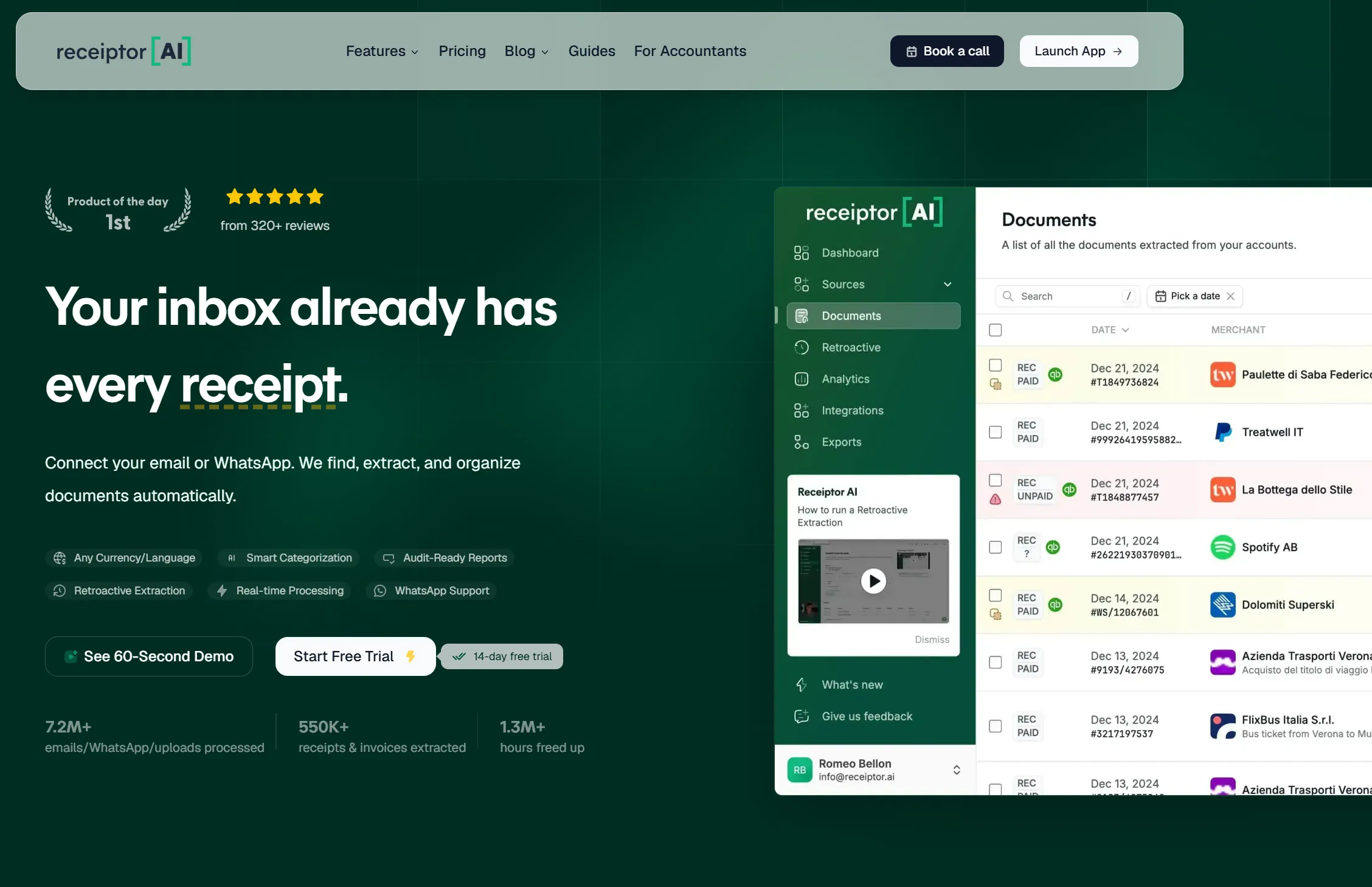
An email-first tool that pulls receipts and invoices out of inboxes automatically rather than waiting for forwarding, aimed at smaller businesses. Lighter on practice tooling than the options above. See Tailride vs Receiptor.
7. WellyBox
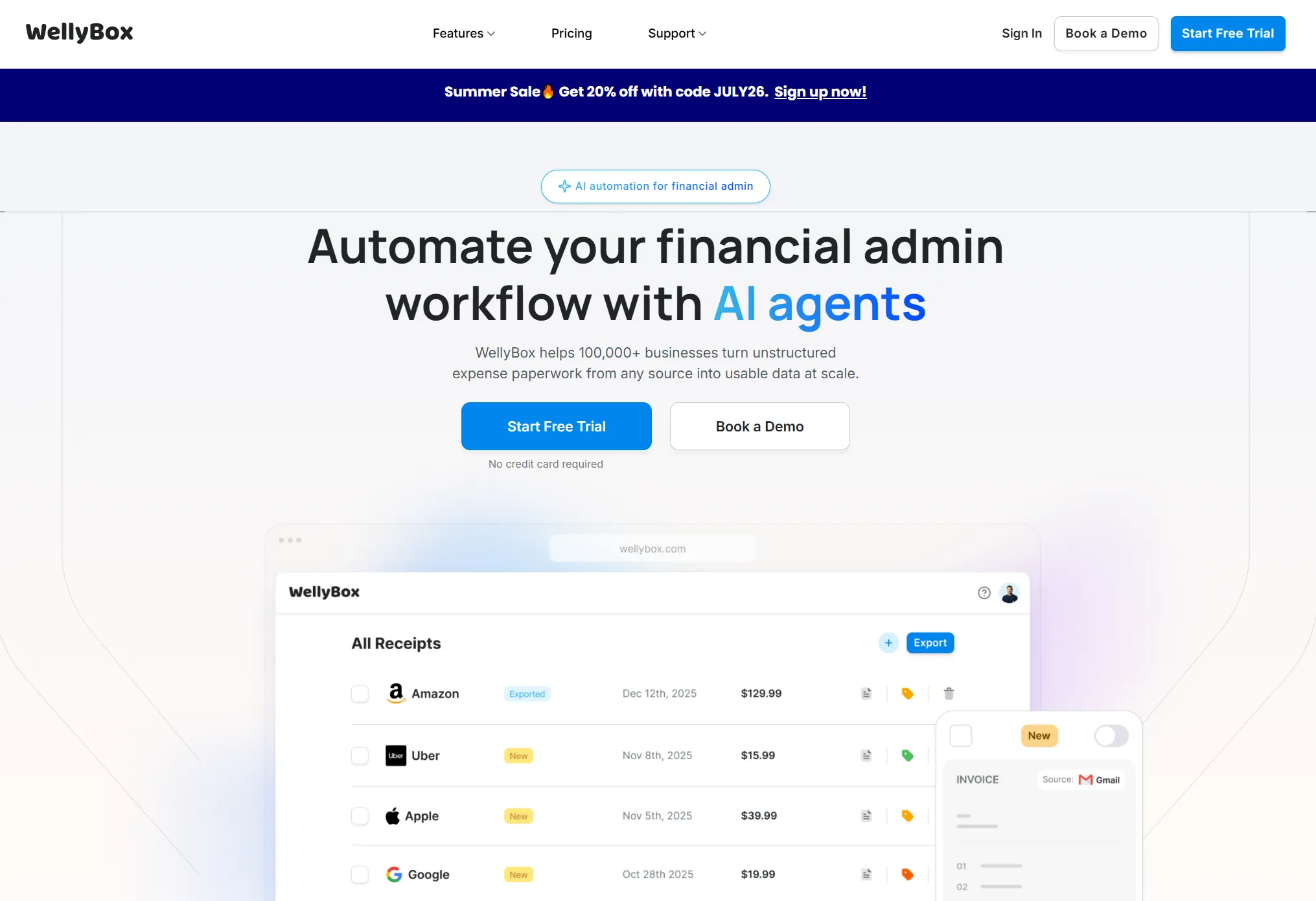
Also inbox-oriented, with a large catalogue of recognised suppliers and a focus on gathering receipts for expense records. A reasonable low-cost option for a sole trader, less suited to a practice managing many clients. See Tailride vs WellyBox.
Comparison at a glance
| Dext | Tailride | Hubdoc | AutoEntry | Lightyear | |
|---|---|---|---|---|---|
| Line items | Credit-metered (5/month free) | Every document, every plan | Not supported | Yes, at higher credit cost | Yes, plus SKU level |
| Email collection | Forward to a @dext address | Direct inbox connection, finds them itself | Forward to a @hubdoc address | Forward or upload | Forward or upload |
| Existing inbox history | From setup onwards | Retroactive scan of past years | From setup onwards | From setup onwards | From setup onwards |
| Portal fetching | Fetch connectors, break on 2FA | Browser extension in your session | Largely retired in 2022 | Limited | Supplier connections |
| Bank reconciliation | Statement OCR by credits | Included, unlimited | Left to Xero | Statement credits | AP focused |
| Practice model | $17.70–19.20/client, 10-client min | Accountant account, no minimum | Per business subscription | Per credit pool | Tiered |
| Entry price | $31.50/mo, no free tier | Free for 10/mo, then $19 | Free with paid Xero | Credit bundles | From ~£130/mo |
| Mobile capture | Best in class | Web-first, upload from any device | Mobile photo | Mobile photo | Limited |
Two columns are worth reading together. Dext and Tailride are close on capability and differ mainly on what is included versus metered, and on how documents are collected. Hubdoc is cheapest by a distance if you are already on Xero and only need storage. Lightyear solves a different problem - purchase orders and approvals - at a price that reflects it.
Where Tailride fits a UK practice
The honest answer is: it fits where collection and coding are the bottleneck, not where receipt photography is.
Onboarding a client starts by connecting their inbox rather than training them to forward things. The retroactive scan pulls the existing history in, so the first conversation is about reviewing coded documents rather than chasing the client for the last quarter's invoices. Portal invoices come in through the extension, in your own session, so the connection does not need repairing every time a supplier tightens security.
From there, each document is read line by line, with the VAT rate taken from the document rather than assumed, and each line coded against that client's chart of accounts. Correct something once and the rule sticks for that supplier and that line description, for that client - so the second month takes less work than the first.
Because the data lands in Xero, QuickBooks or Sage-compatible output with the original document attached, the digital chain MTD asks for stays intact. Nothing is re-keyed in the middle.
A quick way to test any tool on this list: take one builder's merchant invoice with mixed VAT rates and a delivery charge, and see whether the lines and the VAT both come out right without you touching them.
You can start free with 10 invoices a month, no card.
Switching without breaking your VAT trail
-
Export the Dext archive first. Do it while the subscription is live, and keep it as the backup for the period already filed.
-
Connect the client's inbox and let the retroactive scan rebuild the archive. Check the overlap period against Dext's records rather than assuming.
-
Move portal suppliers over through the browser extension, one logged-in session at a time.
-
Run both for a full VAT quarter if the client is on quarterly returns. Compare totals before you switch anything off.
-
Cancel at the renewal date, checking whether the practice is on an annual contract.
The one thing not to do is switch mid-quarter and reconcile afterwards. Overlap costs one month's subscription and saves an argument with a client about a missing bill.
Frequently asked questions
Is there a free alternative to Dext?
Tailride has a permanent free tier covering 10 invoices a month with line-item extraction and bank matching included. Dext offers a 14-day trial and no free plan. Hubdoc is free in a different sense: it costs nothing extra if you already pay for Xero.
Why do Dext Fetch connections keep breaking?
Fetch signs in to supplier sites using credentials stored in the cloud, so it has to be repaired whenever a supplier changes its login flow or turns on two-factor authentication. Fetching through a browser extension inside your own session avoids that class of failure, because the session is already authenticated.
Does Dext extract line items?
Yes, but it is metered. The Business plan includes five line-item credits a month, with more billed on top, and bank statements and supplier statements use the same system.
What does Making Tax Digital require from invoice capture software?
Digital records, HMRC-compatible software, and digital links between systems so data is not retyped or copy-pasted along the way. Failing to keep digital records or maintain those links can attract penalties of up to £3,000, so a workflow ending in a manual import is the thing to avoid.
Can I get a new client's older invoices into the system?
Not with tools that only process what is submitted from setup onwards. Tailride scans the existing inbox history when you connect the account, which is usually the fastest way to rebuild a back catalogue without asking the client to find anything.
Which alternative works best with Sage?
AutoEntry is the natural fit, being Sage-owned. Datamolino and Lightyear also hand off to Sage. Tailride publishes to Xero, QuickBooks and several European ledgers, and exports CSV and an API for everything else.
The takeaway
Dext earns its place on mobile capture and expense workflows. Where UK practices run into friction is elsewhere: line items behind credits, Fetch connections that need repairing, and collection that cannot reach backwards into a client's inbox. Under MTD, that last gap is a records problem as much as a workflow one.
Pick the tool that closes the gap you actually have. If it is coding depth and collection, start free and put one messy supplier invoice through it before you decide.
Related guides
Sources: Making Tax Digital penalties, QuickBooks UK · Dext pricing · Lightyear on the Sage UK Marketplace