How to Download Google Ads Invoices: Single, Bulk & API (2026)
Download Google Ads invoices manually or in bulk - plus Tailride's free Chrome extension for hands-off retrieval across multiple accounts.

Last updated: April 2026 · ~7 min read
Every Google Ads account generates monthly billing documents that feed directly into your accounting workflow - whether that's a solo advertiser reconciling a single account or an agency finance team processing records across dozens of clients. This guide covers every method for Google Ads invoice download: one at a time, in bulk, through third-party extraction tools, and via the API.
This guide is written by the Tailride team - we work on invoice retrieval tooling daily, which gives us a close view of where the native Documents-page approach works well and where it runs into limits at scale.
Note: this guide covers Google Ads (formerly AdWords) billing - not Google Workspace, Google Cloud, Google One, or Google Play, which each have separate billing systems.
TL;DR - Get any Google Ads invoice in 4 ways
Quick answer: navigate to Tools & Settings → Billing → Documents, set a date range, and download individual PDFs or check the master checkbox for ZIP bulk export. Three other paths handle ongoing volume:
-
For solo or single-account use - the Documents page above is sufficient
-
For 50+ invoices/month or multi-account work - the Tailride Chrome extension for Google Ads invoices runs hands-off in your existing browser session
-
For accounting firms managing 5+ client accounts - Tailride for accounting firms consolidates all client billing accounts into one console (free trial available)
-
For enterprise / custom integration - Google Ads API InvoiceService class
Quick navigation: which tier fits your operation
Pick the row that matches your operation, then jump to that section.
| Tier | Best for | Output format | Time per 100 invoices | Where it lives |
|---|---|---|---|---|
| Tier 1 - Single download | Solo advertisers, one-off requests | Individual PDF | ~8–10 hours of operator time | Google Ads Documents page |
| Tier 2 - Bulk ZIP export | SMB finance teams, quarterly reconciliation | ZIP of PDFs | ~2–3 hours of operator time | Google Ads Documents page |
| Tier 3 - Continuous extraction | Agencies, bookkeepers, AP teams | PDF + structured data | ~15 minutes of unattended runtime | Third-party tool or Chrome extension |
| Tier 4 - API integration | Enterprise with custom ERP or BI systems | Structured data, any format | Developer-defined | Google Ads API (InvoiceService) |
Most teams end up at Tier 3. Tier 1 covers one-off retrieval; Tier 2 saves time on quarterly close. Beyond that, agencies and finance teams running 50+ invoices monthly settle on continuous extraction - not because manual is broken, but because Tier 1/2 don't return structured data ready for accounting software. See how Tailride handles Tier 3.
Tier 1 - Download a single invoice from the Documents page
The standard path for a single Google Ads invoice PDF takes fewer than five steps.
-
Log in to ads.google.com and click the wrench icon (Tools & Settings) in the top navigation bar.
-
Under the Billing column, select Documents. This is the Google Ads Documents page - the central repository for all your billing records.
-
If you manage more than one billing account, use the account switcher dropdown at the top of the page to confirm you're viewing the correct billing profile.
-
Set the date range filter to the billing period you need.
-
In the invoice row, click the download link. Two options typically appear:
-
Standard Invoice - the default PDF, sufficient for most internal bookkeeping and expense reports.
-
Invoice with EU VAT - includes full VAT detail required for European accounting and official tax filings.
-
The Documents page stores Google Ads invoices indefinitely - historical records from any prior period remain accessible without a time limit.
Why your Google Ads invoice amount doesn't match your bank charge
This is the most frequent reconciliation issue teams encounter. Google Ads uses a billing threshold system rather than a fixed end-of-month charge: your account accumulates spend and triggers a payment each time cumulative ad costs cross a preset Google Ads payment threshold (commonly $500, €500, or a locally determined limit).
The practical result: a single calendar month can produce two or three separate bank charges, while one invoice may span spend from late in one month and early in the next. The Google Ads billing threshold timing means the invoice reflects the billing period, not the calendar month - so a February invoice might include spend that triggered a charge in January. Always match the invoice billing period to your payment activity log, not the calendar date of the charge.
Invoice generation follows a fixed schedule: Google Ads invoices are published by the 5th business day of the following month. If you're searching on the 1st or 2nd and see nothing for the prior month, the invoice hasn't been issued yet.
Tier 2 - Bulk download Google Ads invoices via ZIP export
When you need multiple Google Ads invoices at once - a full quarter, a calendar year, or a specific reconciliation window - the native bulk export saves significant time over individual downloads.
-
Navigate to Tools & Settings → Billing → Documents (same starting point as Tier 1).
-
Set the date range to cover the full period you need.
-
Once the list refreshes, check the master checkbox at the top of the invoice table to select all visible documents. Alternatively, check individual rows for a selective subset.
-
A Download selected button appears in the toolbar. Click it. Google Ads packages all selected Google Ads bulk invoices into a single ZIP file and downloads it to your machine.
Real-world limitation: Large batch exports - typically spanning more than 12 months on a high-volume account - sometimes time out or return a partial ZIP. The reliable approach is to split the export into 3-month chunks. Four quarter-by-quarter exports instead of one annual pull is more consistent for busy accounts and adds only a few minutes of extra work.
The bulk ZIP method works well for in-house finance teams processing a single Google Ads account. Where it starts to break down is at the agency level: each billing account requires a separate export session, and the output is an unstructured ZIP of PDFs - no CSV, no structured tax data, no direct path into accounting software.
Tier 3 - Continuous extraction tools
For teams that need Google Ads invoices to flow into their accounting stack on an ongoing basis - without manual Documents-page visits each month - third-party extraction tools handle the retrieval in the background.
These tools connect to your existing Google Ads browser session (no password sharing required) and run a sweep for new documents. When a new Google Ads monthly invoice appears, the tool picks it up and forwards it to a connected accounting destination: Xero, QuickBooks, Google Drive, or an ERP endpoint.
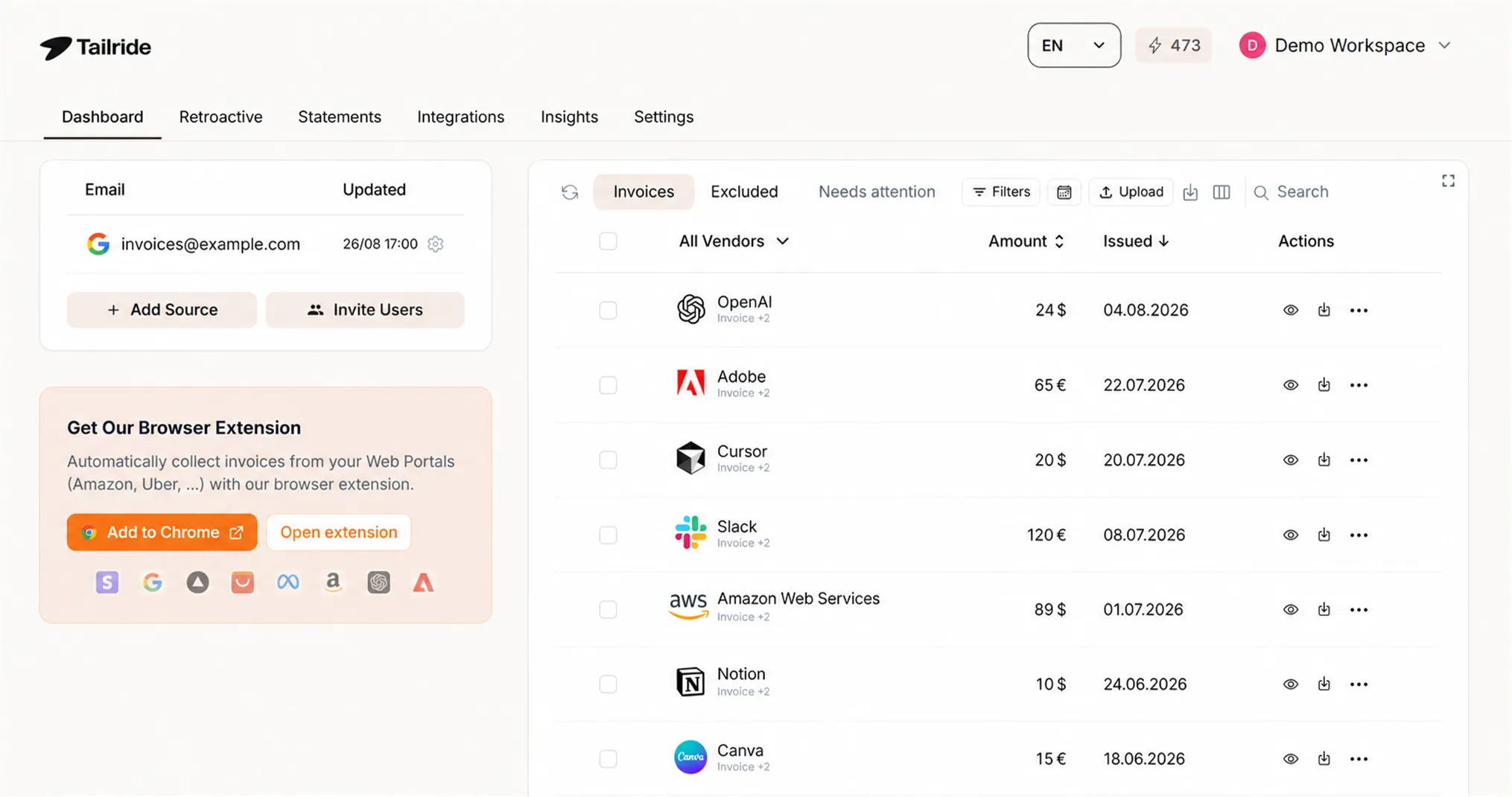
Tailride works this way - a Chrome extension that runs a background extraction pass within your active browser session, retrieving invoices as they're published each month. For teams whose invoices arrive via email rather than the portal, the platform also supports AI inbox scanning, pulling invoice data from Gmail or Outlook without manual forwarding.
Tailride is particularly effective for:
-
Bookkeepers managing 3–10 client accounts who need a consistent, hands-off monthly pipeline
-
In-house finance teams at businesses processing 50+ invoices per month across multiple ad platforms
-
AP teams that require output from automated invoice capture software rather than raw PDFs
Tier 4 - Custom integration via the Google Ads API
Enterprises and development teams with internal BI or ERP systems can pull Google Ads billing data programmatically via the Google Ads API. This gives complete control over retrieval timing, output structure, and downstream routing.
Authentication setup: Before making any API calls, your team creates credentials in the Google Cloud Console - setting up an OAuth 2.0 client ID and configuring the correct API scopes. All requests require OAuth authentication with a developer token linked to a Google Ads Manager Account.
The InvoiceService class is the specific Google Ads API endpoint for invoice retrieval. At a conceptual level, a request to InvoiceService specifies:
-
The billing setup ID - identifies the billing account
-
The issue year and month - the billing period being queried
-
The service type - determines which invoice variant is returned
The service returns a list of available invoice objects for that period, each containing the PDF download URL, invoice ID, billing period, subtotal, tax amount, and total. Your application then fetches each PDF programmatically and routes it to storage or accounting systems - no browser interaction required.
When the API makes sense: Teams building a custom financial dashboard that combines ad spend with CRM revenue data, or enterprises writing invoices directly into a homegrown ERP, will find this approach justified. For everyone else, Tier 2 or Tier 3 reaches the same outcome without the development overhead.
Manager Accounts (MCC) - invoice retrieval for agencies
Agencies operating through a Google Ads Manager Account (also called My Client Center, or MCC) need to understand one structural point: Google Ads invoices live at the billing-account level, not at the Manager Account level.
There is no single "download all invoices for all clients" button in the MCC interface. Each client sub-account is associated with its own billing account, and invoices must be retrieved per billing account separately.
Practical workflow for agencies with 10+ clients:
-
In your MCC, open a specific client sub-account.
-
Navigate to Tools & Settings → Billing → Documents.
-
Confirm the billing account in the switcher dropdown at the top of the Documents page - a client may have multiple billing accounts if they've changed payment methods or restructured their account history.
-
Download the Google Ads invoices for that billing account.
-
Repeat per client.
At 10 clients, this process runs 50–80 minutes monthly at minimum. At 30+ clients, it becomes a significant recurring cost. Tailride's multi-account workflow consolidates this into a single console where all client billing accounts appear in one view, with new documents picked up in the background.
Reading your Google Ads invoice (key fields)
Understanding the structure of a Google Ads invoice PDF prevents reconciliation errors downstream. Key fields to know:
-
Invoice ID - a unique document identifier used for matching payments to invoices in your accounting system
-
Billing period - the date range the invoice covers; may not align with the calendar month due to the Google Ads billing threshold system
-
Campaign breakdown - line items showing spend per campaign or ad service; level of detail varies by account type and billing arrangement
-
Transaction ID - the reference number for the specific payment event; useful when raising a dispute with Google support
-
Tax details (VAT/GST) - shows the applicable rate, jurisdiction, and whether tax has been applied directly or handled via reverse-charge (see next section)
-
Payment method - confirms which card, bank account, or credit line was charged for the billing period
EU VAT and reverse-charge - what it means on your invoice
EU and UK businesses with a valid VAT ID registered in their Google Ads billing profile will see that their Google Ads VAT invoice shows no VAT line item. This is not an error.
Google applies the reverse-charge mechanism for B2B digital services supplied across EU/UK borders. Under reverse-charge, the VAT liability shifts from the supplier (Google) to the recipient (your business). Google does not collect VAT at the point of billing; instead, your business is required to self-account for VAT in your own tax return.
In practice: your Google Ads invoice will show the net amount with a note indicating that reverse-charge applies. Your finance team must post the corresponding VAT in your VAT return as both input and output tax. If your business is not VAT-registered, Google applies the local VAT rate directly and itemizes it clearly on the invoice.
Permissions and access
Not all Google Ads account users can access the Documents page. Invoice download requires one of the following roles:
-
Admin - full access to billing documents by default
-
Billing (dedicated billing-only role) - full access to all billing and payment documents, with no access to campaign settings
-
Standard or Read-only - cannot access billing documents unless explicitly granted billing access by an Admin
If your download button is greyed out or the Documents page is missing from your Tools & Settings menu, you likely have a Standard or Read-only role without billing permissions. To resolve this:
-
Ask the account Admin to navigate to Tools & Settings → Access and security.
-
Have them update your role to include billing access, or assign a billing-only role if campaign-level access isn't needed.
-
If you're accessing a client account through an MCC and still can't see billing, the issue may be at the billing-account level rather than the sub-account level - the billing account holder may need to grant access separately.
For external bookkeepers and accountants, the billing-only role is the appropriate minimum access level - it provides full invoice access without exposing campaign data.
Is manual download enough for your situation?
Running a single Google Ads account with a monthly budget under $10,000? The native Documents page covers everything needed. A single invoice download takes under two minutes, and the bulk ZIP export handles quarterly reconciliation in one session. No additional tooling is required.
Managing an in-house Google Ads account with a finance team that reconciles at month end? Tier 2 bulk download handles most months well. Friction appears in multi-month backlogs or when your accountant needs structured data rather than a folder of PDFs - that's where a Google Ads invoice tool adds real value.
Running a marketing agency with 5–30+ client accounts? The per-billing-account export requirement makes manual Tier 2 a recurring drain - 5–8 minutes per client per month, multiplied across your full portfolio. Tailride for finance teams is purpose-built for this workflow, consolidating all client billing accounts into a single extraction queue.
Building an internal financial system or custom dashboard? Tier 4 (Google Ads API) provides the programmatic access and output control needed to integrate billing data with CRM, ERP, or BI tools without touching the UI.
How this scales: native Documents page vs continuous extraction
| Native Documents page | Continuous extraction (e.g., Tailride) | |
|---|---|---|
| Time per month (10 accounts) | 50–80 minutes of active operator time | 0 minutes - runs in background |
| Output format | ZIP of PDFs only | PDF + structured data synced to accounting software |
| Multiple billing accounts / MCC | Separate export per account required | All accounts in one queue |
At scale: what manual Google Ads invoice work actually costs
For a single account, the Documents page is efficient. The math changes quickly at agency scale.
At 5–8 minutes per billing account - logging in, confirming the account in the switcher, setting the date range, downloading, renaming files, and filing - an agency with 10 clients spends 50–80 minutes each month on invoice retrieval alone. At 30 clients, that's 2.5–4 hours of recurring monthly overhead before any reconciliation work begins. Agencies handling 50+ clients report Google Ads billing admin consuming 6–10 hours of operator time per month.
| Native Documents page | Tailride extraction | |
|---|---|---|
| Time per 100 invoices | 6–10 hours of operator time | ~15 minutes of unattended runtime |
| Format you get back | PDF one-by-one or ZIP bulk export - never both with structured data | PDF + structured CSV + tax breakdown together |
| Multiple billing accounts / MCC | Switch accounts and re-export per account | All accounts and clients in one console |
| Retroactive backlog from prior years | Manual paginated downloads, may hit batch limits | Single full-history scan via retroactive invoice scanning |
| Output ready for accounting | Manual file renaming and folder sorting required | Direct sync to QuickBooks, Xero, Google Drive, or ERP |
| How credentials are handled | Manual login each time, credentials re-entered | Runs in your existing browser session - Tailride never sees the password |
Three routes to solve the scale problem:
-
Browser-session extraction - for invoices retrieved through the Google Ads portal. The Chrome extension for Google Ads invoices runs within your active session and retrieves documents in the background. Install the free Chrome extension for solo or SMB use cases.
-
Inbox-side extraction - for invoices delivered via email. Some billing configurations route Google Ads invoices to a payments email address. Tailride's AI inbox scanning captures these from Gmail or Outlook and structures the data without manual forwarding.
-
Multi-client console - for agencies and accounting firms. The multi-client AP automation console connects all client billing accounts in one view with unified export and accounting sync. Start your 14-day free trial to run it against your current client portfolio.
Common Google Ads invoice problems (troubleshooting)
Why can't I find last month's invoice?
Google Ads publishes invoices by the 5th business day of the following month. Searching on the 1st or 2nd will return nothing for the most recent month - the document hasn't been issued yet. If it's after the 5th business day and the invoice is still missing, check that you're viewing the correct billing account in the switcher dropdown.
Why doesn't the invoice amount match my bank charge?
Google Ads charges your payment method each time cumulative spend crosses the billing threshold, not at a fixed month-end date. A single calendar month can produce two charges if spend crosses the threshold twice, and one invoice may cover a billing period that spans parts of two calendar months. Match the invoice billing period - not the issue date - against your bank transaction history to reconcile correctly.
Why is there no VAT on my invoice?
For VAT-registered businesses in the EU or UK that have provided a valid VAT ID to Google, the reverse-charge mechanism applies. Google does not add VAT to your invoice; your business self-accounts for it in your tax return. The absence of a VAT line on a Google Ads VAT invoice is correct - it reflects standard B2B cross-border digital services treatment, not a billing error.
How do I change the billing address on an old invoice?
A Google Ads invoice that has already been issued cannot be retroactively edited. To update billing name or address for future invoices, navigate to Tools & Settings → Billing → Billing settings and update your payments profile before the next billing cycle begins. Changes take effect on the next invoice generated after the update.
My download button is greyed out
A greyed-out download button almost always indicates insufficient role permissions. Standard and Read-only users cannot access billing documents without explicit billing access. Ask the account Admin to update your role in Tools & Settings → Access and security, or request a billing-only role if you need invoices without broader account access.
I have multiple billing accounts - which one has my invoice?
If you've changed payment methods, restructured your account, or run spend across different billing setups, you may have more than one billing account linked to your login. On the Documents page, use the account switcher dropdown at the top to cycle through available billing accounts. The invoice in question will be under the billing account that was active during that billing period.
FAQ
What file format do Google Ads invoices come in?
Google Ads generates invoices as PDF files. There is no native CSV or spreadsheet export from the Documents page. Structured data output - with line items and tax fields parsed - requires the Google Ads API InvoiceService or a third-party extraction tool.
Is there a limit on how many invoices I can export in one bulk download?
Google doesn't publish an official cap, but exports spanning 12+ months on high-volume accounts frequently time out or return partial ZIPs. Splitting exports into 3-month chunks avoids this. For full-history retrieval, the bulk Google Ads invoice extractor handles pagination without manual intervention.
Can I get Google Ads invoices sent to my email automatically?
Yes. In Tools & Settings → Billing → Billing settings, add one or more Google Ads invoice email recipients. Google sends a notification with the invoice attached each month when a new document is issued. This Google Ads invoice email delivery works for individual accounts but doesn't consolidate across multiple billing accounts.
How far back does Google Ads store invoices?
The Google Ads Documents page retains billing records indefinitely. Historical invoices from any prior billing period are accessible at any time. For large retroactive backlogs, retroactive invoice scanning can process multi-year histories in a single pass.
Do MCC sub-accounts have their own invoices, or does the Manager Account receive them?
Invoices are generated at the billing-account level, not at the My Client Center (MCC) level. Each sub-account's billing account has its own invoice history. The MCC dashboard does not aggregate or centralize Google Ads invoices across clients - each billing account must be accessed individually unless you use a purpose-built for accounting workflows multi-client console.
Where do I find invoices for older Google AdWords accounts?
Google AdWords was rebranded to Google Ads in 2018. Legacy AdWords invoice history is available in the same Google Ads Documents page under the same billing account - use the date range filter to reach historical AdWords invoice records.
Can I retrieve Google Ads invoices without logging into the UI each month?
Yes - either via the Google Ads API (InvoiceService) for programmatic access, or via a browser-based extraction tool that retrieves documents within an existing authenticated session. The automated Google Ads invoice extraction page covers all available connection methods in detail.
Related guides
-
How to Get Google Ads Invoices and Receipts - the complete vendor hub covering all retrieval paths for Google Ads billing
-
How to Download Meta Ads Invoices - the same 4-tier walkthrough for Facebook and Instagram ad billing
-
AP automation for accounting firms - how multi-client AP teams handle invoice collection at scale
-
Tailride for finance teams - purpose-built for accounting workflows across multiple clients and platforms
-
Automated invoice capture software - broader guide to document capture across all vendor types
-
AI inbox scanning - for invoices arriving via email rather than billing portals
